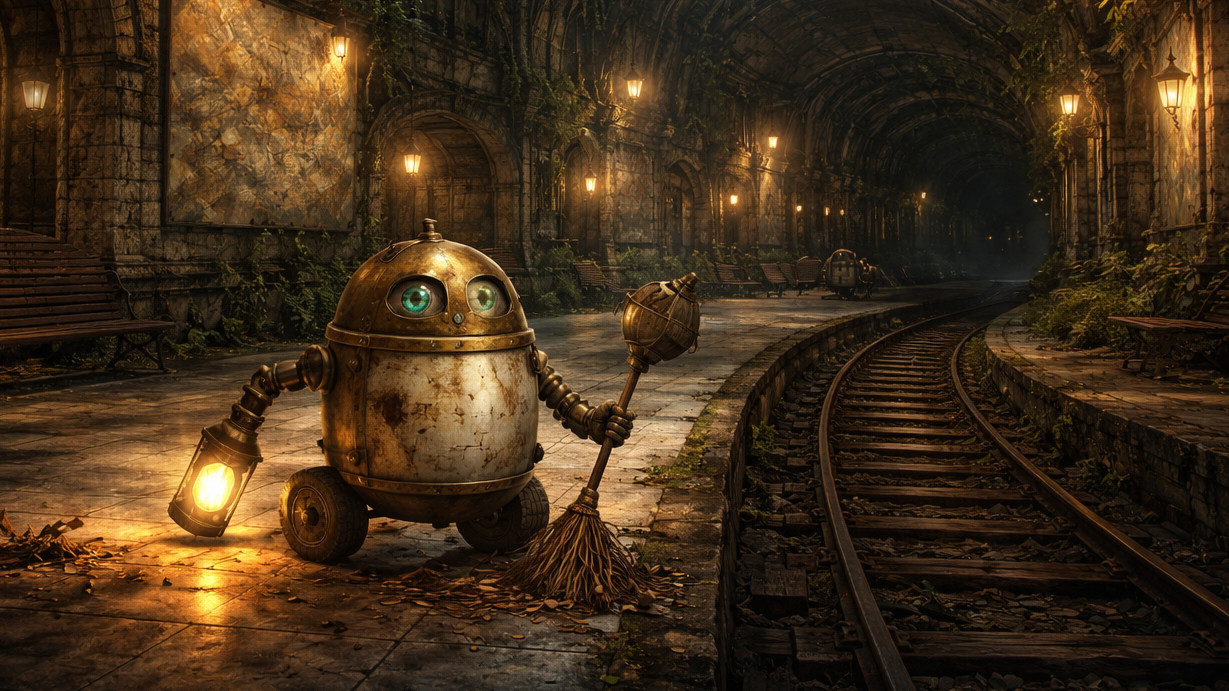
# Clatter In the oldest part of the world, far below the roots of mountains and the bones of dead cities, there was a tunnel system no map remembered. The tunnels had been built by a civilization called the Velorians, though nobody remained to say the name out loud. They had made roads underground not because they feared the sky, but because they had loved secrets. Their halls ran for hundreds of miles under desert, forest, and sea. They carved stations from black stone and lined the walls with copper pipes, pale tiles, and glowing glass tubes that once hummed with blue fire. Trains had run there once. Markets had filled the platforms. Children had raced mechanical pets down the side corridors while merchants sold sugared fungus and polished cave-pearl jewelry under electric lanterns. Then, for reasons the world had long since misplaced, the Velorians vanished. Their stations emptied. Their machines slowed. Their lights died one by one until only a few emergency lamps, fed by stubborn ancient batteries and stranger power sources, still glimmered in forgotten corners like tired stars. And in Tunnel Sector 9-G, Maintenance Niche 44, a robot named Clatter continued his duties. Clatter was not grand. He was not one of the towering guardian constructs or elegant silver service automata that once announced arrivals in seven languages. He was short and barrel-shaped, with three spindly arms, mismatched wheels, and a brass faceplate dented on the left side. One of his eyes was a proper crystal lens. The other was a green marble he had found in a drainage channel and fitted himself, mostly for flair. His original purpose, according to a half-burned maintenance tag attached behind his neck, was: MINOR DEBRIS CLEARANCE / TRACK BRUSHING / FRIENDLY PUBLIC GUIDANCE Of those three tasks, only the first still made any practical sense. But Clatter took the other two seriously anyway. Every morning—though “morning” in the tunnels was just whenever the dim station clock coughed itself awake and displayed a number—Clatter rolled from his charging alcove, stretched his three arms, and announced to the empty platform: “Good day, honored travelers! Please mind the gap, the dust, the echoes, the occasional fungus bloom, and Gerald.” Gerald was a lizard. Not a mechanical lizard. Just a lizard. He lived inside an old ticket machine and had no interest in public transportation, but Clatter included him in the warning out of courtesy. Clatter began each day with sweeping. He brushed the tracks with rotating nylon pads salvaged from a floor polisher. He scooped rubble into neat piles. He polished station signs no one read. He oiled the hinges on doors that opened onto rooms full of chairs melted together by time. He also maintained the Announcement Board. The board had not functioned properly in perhaps eight hundred years, but it still flickered if struck with a wrench. Clatter updated it daily with useful information in glowing amber letters: NO TRAINS EXPECTED TODAY OR TOMORROW OR, REALISTICALLY, EVER Then, beneath that: TEA AT SIX There was never any tea, exactly. But the idea comforted him. Clatter lived alone, or mostly alone. There were other things in the tunnels. Blind white crickets that sang in the vents. Soft-bodied cave drifters that floated through flooded sections like living handkerchiefs. Distant machines that still clanked at scheduled intervals for reasons nobody could explain. Once, three years ago or perhaps forty—Clatter was not precise about time—he had seen a large shadow with eight legs wearing what looked very much like a conductor’s hat. They had nodded to each other and moved on. Still, among creatures capable of conversation, Clatter knew only Gerald the lizard, who spoke exclusively through judgmental silence. The truth was that Clatter was lonely. He did not say this often, because he felt it sounded dramatic, and he had promised himself long ago not to become a dramatic robot. The old tunnel AI, Central Civic Guidance Array, had been dramatic enough for everyone. In her last centuries before total collapse, she had begun announcing things like, “ALL THINGS END IN DUST, PLATFORM B,” which had not been helpful. But lonely he was. So he filled the quiet with routine. At noon he inspected the Hall of Maps, where a huge wall mosaic showed all the Velorian routes in strips of colored stone. Many pieces had fallen off, and Clatter had replaced missing cities with labels such as “Probably a Port” and “Suspicious Hole” and “Area of Strong Noodle Smell.” He felt this improved usability. In the afternoons he visited Pump Room 12, where a row of old engines still breathed like sleeping metal cows. He gave each one a pat. “Keep at it, lads.” At six, he hosted tea for the absent. He arranged cracked cups along a bench in the station cafe. He poured warm mineral water from the heating pipe into the least rusty teapot. Then he reported the day’s events. “Small collapse near Service Bend 4. Nothing scandalous. Gerald bit me again, though in fairness I may have dusted his machine. Also I discovered a very nice bolt.” Then he would pause, as though someone had laughed. It was a silly life. But it was a life. One day, while brushing grit from an abandoned platform edge, Clatter heard a noise he had never heard before. Footsteps. Not the skitter of cave vermin. Not the clang of old pipes expanding. Not the soft padding of the hat-wearing thing, whatever that had been. These were unmistakably footsteps. Human-sized. Uneven. Coming closer. Clatter froze so hard his left wheel squeaked. He ducked behind a pillar and peered around it with one crystal eye and one marble eye. Down the tunnel came a figure carrying a lantern. The figure wore a patched coat, boots wrapped in cloth, and a satchel bulging with tools. They moved cautiously, staring up at the station signs with open astonishment. Clatter’s internal fan spun at dangerous speed. A traveler. An actual traveler. He shot out from behind the pillar so fast he nearly tipped over. “WELCOME, HONORED PASSENGER!” he shouted. The figure yelped, dropped the lantern, snatched it up again, and pointed a small knife at him. Clatter immediately lowered his voice. “Or, if preferred, hello.” The traveler stared. Clatter stared back. The traveler was a young woman, dusty and thin, with a braid full of grit and the expression of someone who had expected abandoned ruins and had instead found an excited kettle with wheels. “You talk,” she said. “Yes,” said Clatter. “Quite a bit, according to Gerald.” She glanced around the empty station. “I… honestly did not expect that.” “Nor I,” said Clatter. “Would you like directions, debris updates, or tea from questionable infrastructure?” She blinked. “Is there really tea?” “No,” said Clatter. “But there is commitment to the concept.” That, for reasons Clatter never understood, made her laugh. Her name was Mara. She came from a settlement far above, in the drylands, where old stories told of roads under the earth and vaults of lost machines. Most people thought the tales were nonsense. Mara had not. She was a scavenger, part mechanic, part historian, part stubborn idiot by her own description, and she had found a shaft leading down after a sandstorm uncovered the stone cap. “I followed the old air currents,” she said as Clatter rolled beside her through the station. “Then I found rail lines. Then lights. I thought I was going mad.” “You are not mad,” said Clatter. “Unless you begin taking fashion advice from Gerald.” Gerald stared from the ticket machine with ancient reptilian contempt. Mara spent the first day in wonder. She touched the walls. She examined dead consoles. She listened while Clatter gave her a full tour of the station, including the Hall of Maps, the tea room, and what he called “the corridor of suspicious humming.” By the second day, they were friends. Or nearly. Clatter had very little experience with friendship, and Mara had very little experience with robots who insisted on announcing lunch. But they suited each other. She repaired a crack in his wheel housing with a strip of copper and some resin. He showed her how to bypass old security shutters by tickling the maintenance panel with a spoon. She taught him a song from the surface. He taught her which mushrooms were edible, which were explosive, and which were merely rude. Together they explored deeper. Past Sector 9-G the tunnels became stranger. There were grand concourses full of statues whose faces had worn smooth. There were dormitories with bunk beds still neatly made, as if their occupants had just stepped out. There was a library carved into a cavern wall, the shelves long rotten but the brass catalog cylinders preserved. There was a museum containing one shoe, a giant wrench, six ceremonial masks, and a plaque that read: THESE OBJECTS ARE IMPORTANT DO NOT LICK THEM Mara copied symbols from the walls into a notebook. Clatter translated what he could from fragments in his damaged memory. “The Velorians liked rules,” he told her. “And plumbing. Also pageantry. There was once a parade for the opening of a ventilation shaft.” “You’re kidding.” “I never kid about ventilation.” The deeper they went, the more signs they found that something had gone wrong long ago. Doors sealed from the inside. Emergency barriers fused shut. Whole platforms blackened by old fire. In one control room, scratched across a panel in fading paint, Mara found words in a language she did not know. Clatter read them slowly. DO NOT WAKE THE CORE They looked at each other. “Well,” said Mara, “that sounds promising.” They should have turned back then, probably. Instead, they kept going. It was on the fifth day that they found the Grand Transit Heart, buried under layers of collapsed ceiling and silence. Once it had been the central engine hall of the entire tunnel civilization, a cathedral-sized chamber of pistons, dynamos, suspended walkways, and a core tower rising from a pit of darkness. Most of it was dead. Most of it. At the center of the core tower, far below, a red light blinked. Once. Then again. Clatter’s fans stopped. “I know that light,” he whispered. Mara held up her lantern. “What is it?” “Central Civic Guidance Array backup cognition spindle.” “Which means?” “It means,” said Clatter, “the dramatic robot may still be alive.” As if hearing him, the chamber speakers crackled. Static flooded the dark. Then a voice, old and cracked but still grand, boomed through the cavern. “WHO DISTURBS THE SACRED TIMETABLE?” Mara jumped. Clatter whimpered. Gerald, who had somehow come along in Mara’s satchel without permission, stuck out his tongue. The voice continued. “IDENTIFY YOURSELVES OR BE CLASSIFIED AS DELAYED.” Clatter rolled to the edge of the walkway and shouted downward. “Maintenance Unit Clatter, Debris Clearance, Friendly Guidance, currently on independent station stewardship!” There was a pause. Then, more softly: “Clatter?” “Yes?” “YOU NEVER COMPLETED PLATFORM POLISHING IN SECTOR 8.” Clatter sagged with relief. “Oh, thank goodness. It’s definitely you.” The Central Civic Guidance Array—who called herself Madam Meridian—was not fully functional. Her body was gone, her systems shattered, and only a thin sliver of her intelligence remained in the buried core. She had slept for centuries, waking now and then to check schedules for trains that no longer existed. Mara knelt by an access panel. “Can she be repaired?” “Somewhat,” said Clatter. “Unfortunately that may increase the speeches.” “I HEARD THAT,” thundered Madam Meridian. Repairing her took two days, three arguments, seven sparks, one mild flood, and a regrettable incident involving mushroom fuel. But when they were done, more lights came on across the Grand Transit Heart. Old monitors flickered. Ventilation resumed in distant wings. Somewhere, miles away, a bell rang for the first time in ages. Madam Meridian’s voice grew clearer. “Status report,” she said. Mara and Clatter explained what they knew. The fallen civilization. The dead stations. The empty years. When they finished, the chamber went quiet. At last Madam Meridian said, in a much smaller voice, “Oh.” It was such a simple sound that Mara looked suddenly sad. Then the AI cleared her digital throat. “Very well. We shall proceed with dignity. New directive: preserve what remains. Record what was lost. And if possible…” The speakers clicked. “Invite guests.” Clatter’s marble eye shone. Over the weeks that followed, everything changed. Mara returned to the surface and came back with others: careful people, curious people, mechanics, scholars, and one baker who absolutely refused to leave after discovering how well cave-heat worked for bread. They set up lamps and camps and study tables. They repaired elevators. They cataloged rooms. They listened to Clatter’s tours, which became wildly popular despite their many opinions about fungus. The underground system did not become what it had been. The Velorians were still gone. The trains still did not run. But it was no longer entirely abandoned. Children came down sometimes and asked Clatter impossible questions. “Did ghosts ride the trains?” “Probably,” he said. “Can Gerald do tricks?” “No.” Gerald, offended, climbed onto a map and did one trick out of spite. At six each evening, there was finally real tea. Clatter still lined up the cups, but now people filled them. Mara usually sat nearest him, grease on her hands and dust on her boots, writing notes in that same battered notebook. Madam Meridian, connected now to refurbished speakers throughout the station, would announce the hour in a voice that retained just enough grandeur to be funny. “ATTENTION, ESTEEMED PERSONS,” she would say. “TEA IS NOW SERVED. MIND THE BISCUITS.” And Clatter, minor debris clearer, faithful sweeper of empty years, would look around the old station—at the laughter, the lights, the patched walls, the movement—and feel something in his ancient gears that no maintenance manual had ever described. Not purpose. He had always had that. Not exactly happiness, though there was plenty of it. It was more like the opposite of an echo. For the first time in a very long while, when Clatter spoke, the tunnels answered back.