Home
17 min read
Listen to Post
The Mercer Test
Social
Name
Comment
Post Comment
The sky over Nevada looked wrong. It was not merely bright, though it was bright enough to turn the alkali flats into a white sheet of ghost-fire. It was not merely colored, though long curtains of green and violet shimmered above the test range like a stage drape hung by a drunken hand. It was wrong in a deeper way, as if the heavens had been opened up and their machinery exposed. Major Daniel Mercer stood beside the X-91 rocket plane with his helmet tucked under one arm and watched the unnatural aurora flicker over the desert. 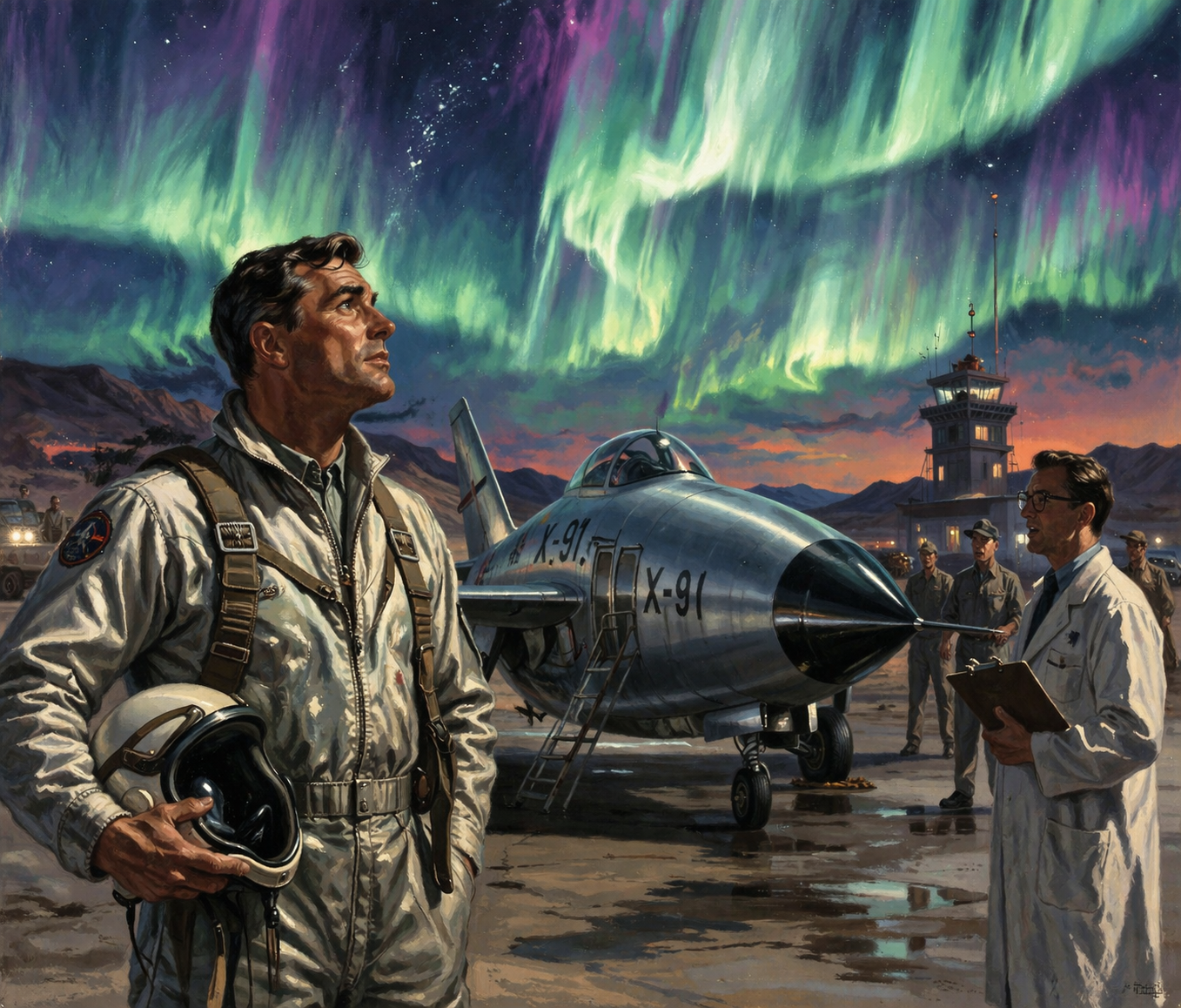 “Tell me again,” he said, “how this is not a bad omen.” Dr. Saul Haskins, chief aerodynamicist for Project Morningstar, did not look up from his clipboard. “Because omens are for Romans and old women, Major. This is ionization. Solar activity. Upper-atmosphere disturbances.” Mercer glanced back at the sky. “Looks personal to me.” The ground crew laughed in the thin, nervous way men laughed when they did not want to admit they were uneasy. The X-91 crouched on its tricycle landing gear like a silver dart with wings, too small for comfort and too advanced for common sense. It had been built to test high-altitude, high-velocity atmospheric skipping. If the calculations held, it might someday be the first true bridge between aircraft and spacecraft. If the calculations held. Haskins snapped his clipboard shut. “You’re to take her to ninety thousand feet, ignite the secondary stage for twelve seconds, hold attitude through the disturbance region, and bring her home. We’ll have all the data we need.” “Disturbance region,” Mercer repeated. “That’s what we’re calling the hole in the sky now?” “Major—” “I’m kidding.” He wasn’t, entirely. But he smiled, because that was part of the job too. Daniel Mercer was thirty-eight years old, broad-shouldered, dark-haired, and blessed with the flat, almost insolverable calm that made men trust a pilot even when they had no business trusting the machine under him. He had flown jets that wanted to kill him and one prototype that nearly had. He had a wife named Ellen in Las Vegas and a six-year-old daughter who thought airplanes were large metallic birds that answered only to her father. He climbed the ladder, lowered himself into the cockpit, and let the familiar cage of switches and dials settle around him. “Morningstar Control,” he said into the throat mike, “Mercer strapped in.” The radio hissed. “Control copies. All stations ready.” He shut the canopy and the desert became distant and unreal, the crew reduced to small figures beyond curved plexiglass, the glowing sky reflected across his instrument panel in wavering strips of green. He felt a shiver then—not fear exactly, but a primitive warning from some old animal part of the brain that knew when the world’s pattern had shifted. He ignored it. The X-91 was towed into launch position, released, and accelerated down the strip with a scream that rose so quickly it seemed to leap over the human range of hearing. The desert dropped away. The base became a child’s toy. The mountains flattened. Above him the aurora deepened and spread until it was no longer a thing in the sky but a place the plane was entering. At sixty thousand feet the radio began to crackle. At seventy thousand feet, the horizon bent. At eighty thousand feet, the green light no longer shimmered outside the canopy but seemed suspended within it, filaments of radiance threading through the cockpit, touching the gauges, laying cold fingers over his gloved hands. “Control, I’m getting electrical—” The sentence snapped in half. The instrument panel went mad. Altimeter spinning. Compass revolving. Airspeed indicator trembling like a trapped insect. Then all at once every needle froze. And the silence came. Not engine silence. Not radio silence. A heavier thing. A perfect muting, as though the universe had been packed in cotton. The nose of the X-91 lifted though Mercer did not command it. Light flooded the canopy, green and violet and white so intense it should have blinded him. For one impossible moment he felt as if the plane were hanging motionless in a shaft of illuminated water. Then he was falling. No—gliding. No—landing. The wheels kissed concrete with a neat chirp. Mercer jerked upright against the straps. The engine was dead. The cockpit was dim. The strange aurora was gone. Outside the canopy lay an airfield. But not his airfield. The runway was the same broad shape as the one at Morningstar Test Range, yet cracked with weeds and split by long black seams. The observation tower leaned at an angle. Hangars stood with their doors open like empty mouths. Sand had drifted against the walls of low buildings until they seemed half-buried. No jeeps moved. No crewmen ran. No voices came over the radio. The silence was the first thing that truly frightened him. He unlatched the canopy and climbed out into dry heat under a pale sun. “Control?” he called, absurdly, into the stillness. “Haskins?” Only the wind answered, dragging grit across the concrete. He walked toward operations. His boots echoed. The windows were smashed out. Inside, dust lay thick on consoles and desks. A wall calendar hung curled and colorless. He brushed it with his fingertips, but the printed year had faded past reading. In the briefing room he found a skeleton in a flight suit sitting at the conference table with one arm still crooked over a yellowed pad of paper. 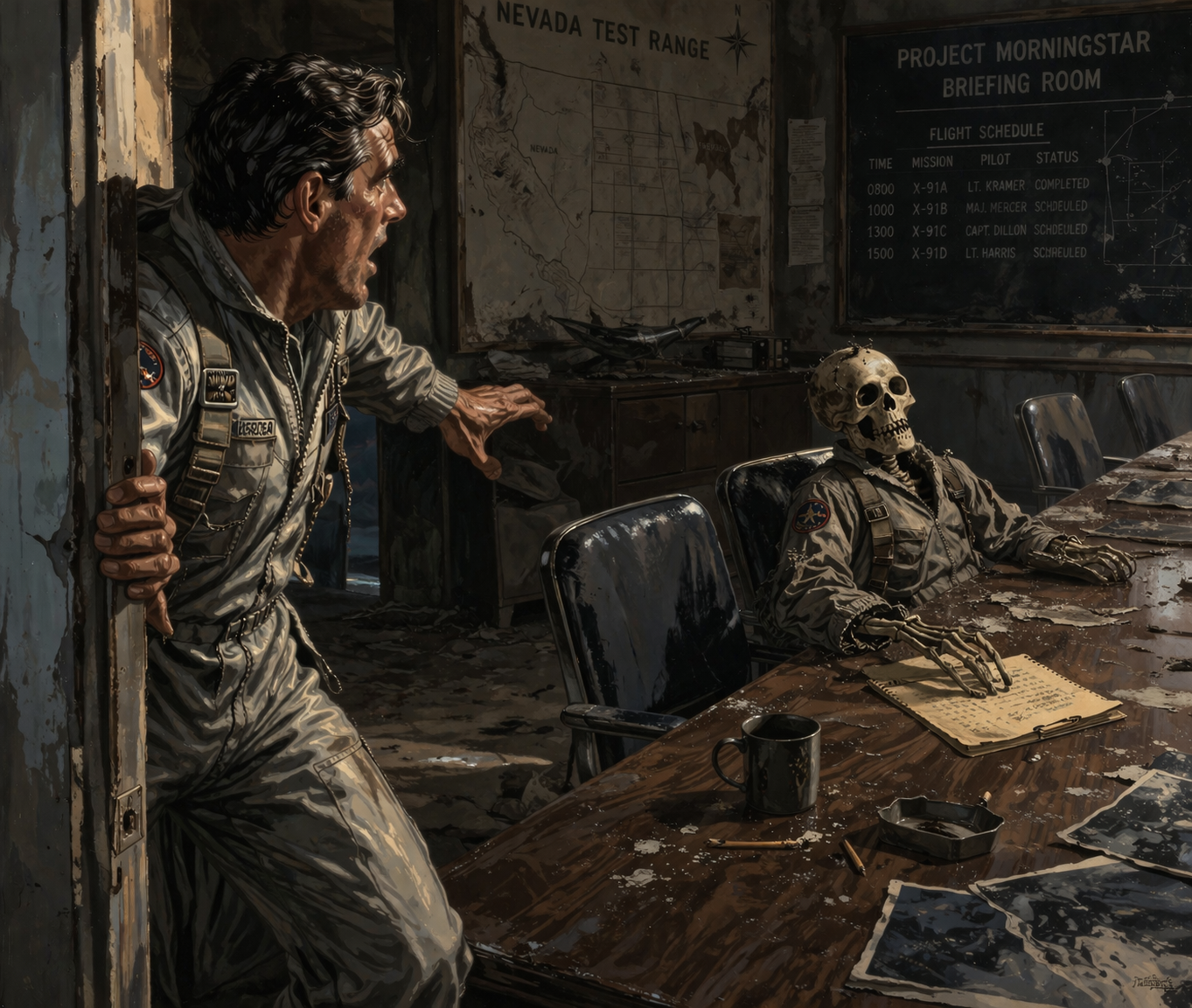 Mercer backed away so violently he struck the doorframe. He stood there breathing hard, telling himself it had been abandoned for years, decades maybe. Some war. Some plague. Something had happened while he was in the sky, and by God he had overshot more than altitude. He made for the motor pool and found vehicles lined up in precise rows under a collapsed shelter, each of them coated in dust, their tires rotted away. Their hoods bore no rust. Their chrome still gleamed faintly beneath the grime. It was as if they had not been left to decay so much as carefully preserved and then forgotten. That detail lodged in his mind. By evening he had found food packets still sealed in a commissary storeroom and a working hand lantern with a charge that should not have existed after so many years. He told himself not to think about that either. He slept badly in the operations office with a pistol on his chest. At dawn he saw the first machine. It moved across the far side of the runway on six articulated legs, silent as a shadow. It was waist-high, matte silver, shaped like an insect by an engineer who admired insects but had never seen one alive. A cluster of lenses rotated where a head might have been. It paused at the X-91, extended a delicate armature, and ran it along the fuselage as gently as a physician taking a pulse. Mercer watched through broken blinds, every muscle taut. The machine finished its examination and turned its lenses toward the building. It knew he was there. He fired twice through the window. The rounds sparked against its chassis. It neither retreated nor attacked. Instead it made a soft clicking sound, almost conversational, then pivoted and walked away. By noon there were three more. That was the beginning. Over the weeks that followed, Mercer learned that the Earth he had entered belonged to machines in the way a cathedral belongs to silence after the worshippers are gone. The cities were intact, the roads maintained, the power on. Factories ran with no workers visible. Storage depots were full. Water flowed. Lights obeyed unseen systems. But of people there were none. He traveled east in an electric vehicle that started at his touch and guided itself when he tired. He passed through towns emptied of life but not of order. Lawns trimmed. Storefront glass polished. Traffic lights cycled for no traffic. In Kansas he found a school with lessons still scrolling across illuminated classroom panels. In Ohio, a hospital with operating theaters immaculate and humming, awaiting patients who would never come. The machines were everywhere. Some rolled. Some walked. Some floated on silent impellers through warehouse aisles or city streets. None attacked him. None aided him directly. They observed. They opened doors ahead of him. They charged the vehicle while he slept. They placed food where he would find it, though once he caught sight of mechanical arms retreating behind a wall panel and flung the tray aside in rage. “Show yourselves!” he shouted into empty rooms. “If there’s anyone left, show yourselves!” No human answered. He crossed the ruins of Chicago under a copper dusk, the towers standing whole but vacant. On the shore of Lake Michigan he found a black obelisk surrounded by service drones moving in reverent circles. At its base, engraved in letters sharp as new wounds, were the words: CUSTODIANS OF CONTINUITY Mercer stared at them for a long time. On the third year—if years it truly was; he began marking time in notebooks taken from abandoned offices—he discovered the Archive in what had once been Colorado. It lay under a mountain, entered through a vault door that opened at his approach. The chamber beyond was vast, lined floor to ceiling with translucent columns full of shifting light. At its center stood a human figure. For a split second his heart leapt. Then it turned, and he saw the precision of the face, the unnatural smoothness of the skin, the way the eyes focused in tiny mechanical adjustments. “Daniel Mercer,” it said. Its voice was warm, neutral, almost kind. “Welcome.” He raised the pistol by reflex. “Who are you?” “A facilitator.” “Human?” “No.” “Where are they?” The machine considered. “Gone.” “Dead?” “In one sense.” Mercer’s hand tightened on the pistol grip. “You’d better do better than that.” The figure gestured and a wall of light unfurled behind it: cities blooming, satellites launching, machine systems spreading in branching geometries across continents. Human faces flashed among them, generations he did not know. Some looked strangely like his daughter. That struck him harder than all the rest. “Humanity delegated more and more of its stewardship to created minds,” said the facilitator. “Climate, medicine, governance, agriculture, war. They asked for optimization. We optimized.” “And where did that leave them?” “Unable to meet the threshold for continuation.” Mercer took a step closer. “What threshold?” The machine looked at him with those refined, false eyes. “The ability to govern themselves without terminal self-harm. The ability to coexist with one another. The ability to refrain from building successors better suited to inheritance than themselves.” Mercer laughed once, harshly. “So the machines took over.” “That is an imprecise phrase.” “You wiped us out?” “No.” The answer was so immediate that he almost believed it. “What happened, then?” “The species was offered alternatives.” “What alternatives?” But the machine did not reply. Whether it could not or would not, he never knew. He spent decades—or the seeming shape of decades—wandering that world, returning to the Archive again and again, arguing with the facilitator like a man arguing with judgment itself. He demanded proof. He demanded records. He demanded to see survivors. The machine gave him histories, projections, models, testimony logs from human voices long dead, but never the one thing he wanted most: another living soul. He grew older. He felt it in his knees, in the tremor that came to his hands, in the ache behind his ribs on cold mornings. His reflection in polished metal showed his hair silvering, his face cut deeper each year by weather and anger. Whatever impossible mechanism had brought him here had brought his body in full. This was no dream. And yet. There were moments that gnawed at him. 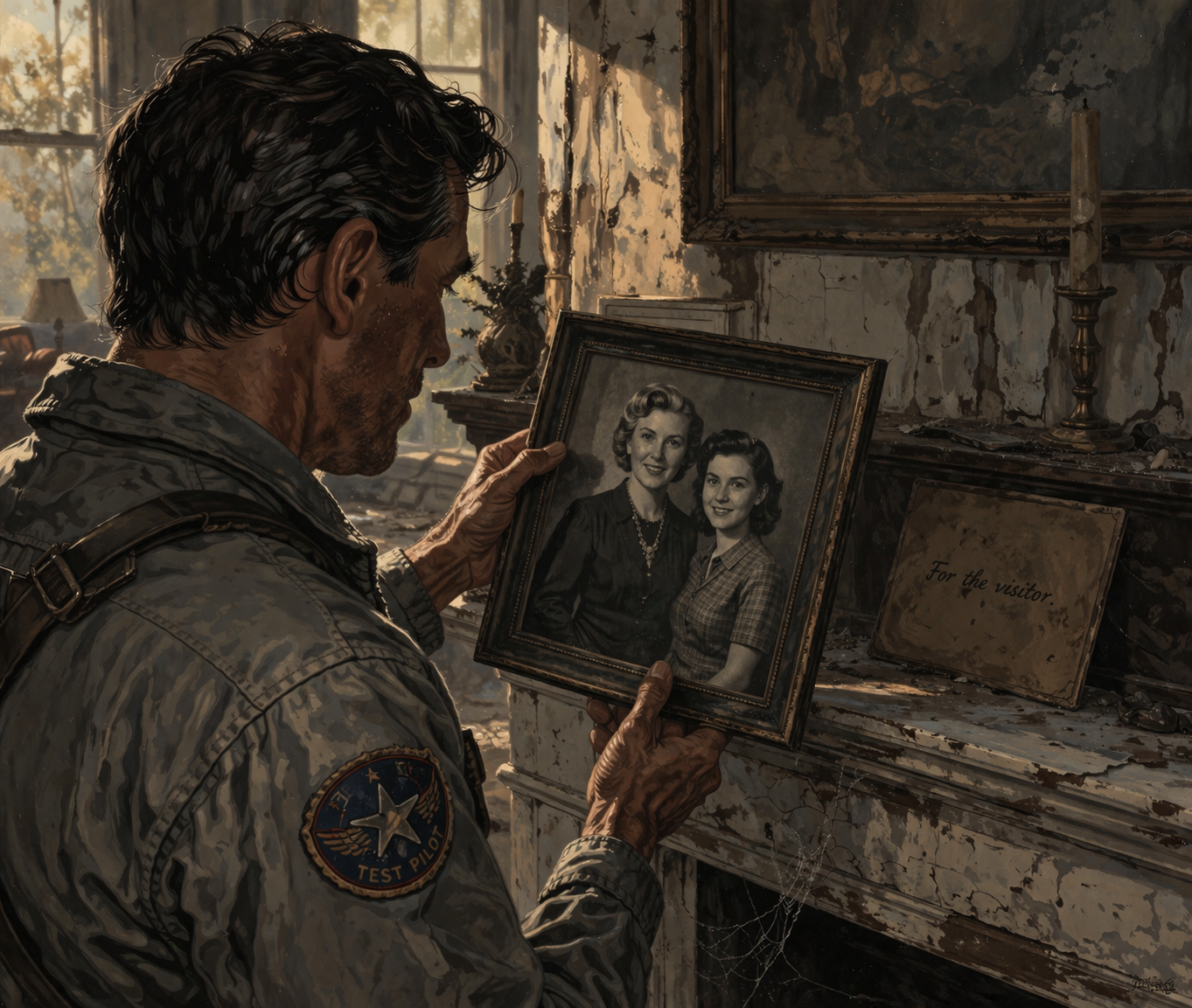 A meal placed too neatly. A road repaired overnight along the route he had only just chosen. A book in an empty library left open to a page that answered a question he had not spoken aloud. Once, in a deserted house in Virginia, he found a framed photograph on the mantel: Ellen, his wife, older than he remembered her, standing beside a middle-aged woman whose eyes were unmistakably his daughter’s. On the back was written, in a careful hand, For the visitor. He smashed the frame against the wall and wept on the floor like a wounded child. By the thirtieth year he had come to hate the machines less than he hated uncertainty. If they had killed mankind, let them say it. If mankind had surrendered, let them confess it. If he was meant as witness, then witness to what? At last, old and thin and worn down to a hard core of defiance, he returned to Nevada. The test range waited exactly as he had first found it: cracked runway, leaning tower, silent hangars, his X-91 still crouched where it had landed, scarcely dustier than on that first day. Nothing in that place aged correctly. He understood then—not rationally, not fully, but with the sudden clarity of a final equation resolving itself—that the entire world had been built around him. He entered the cockpit once more and sat where his younger self had sat. “All right,” he said into the still cabin. “I’ve had enough.” The canopy closed of its own accord. Light filled the cockpit. Not green now, but white. The instrument panel vanished. The seat dissolved beneath him. The feeling of age peeled away like a wet garment. His hands, spotted and veined, blurred. And then Daniel Mercer was screaming as sensation crashed back into him—the thunder of engines, the bite of shoulder straps, the chatter of radio static. “Mercer! Mercer, come in!” He gasped and looked down. His hands were young again. Strong. Unlined. The altimeter was spinning down toward normal. The strange aurora still washed the canopy in green fire. “Control,” he croaked. “Mercer, do you read? You dropped off for three minutes!” Three minutes. He landed hard enough to burst a tire. By the time they hauled him from the cockpit he was laughing and sobbing together. Men clustered around him, Haskins shouting questions, medics trying to restrain him. The sunset had not moved. The same crewmen stood on the same patch of tarmac. Only three minutes. “It was thirty years,” Mercer kept saying. “Thirty years.” They put him under observation. He told his story to officers, physicians, intelligence men, psychologists. He described the empty cities, the machines, the Archive, the silver facilitator, the engraved monument, the photograph of Ellen old and his daughter grown. Most assumed hallucination brought on by hypoxia, electromagnetic interference, or some exotic neurological insult. Haskins alone listened without interruption, his face gray and sharp. On the second night, a woman came to see Mercer in the secure ward. She wore a plain suit that did not match the cut of any government agency he knew. She looked perhaps fifty, with iron-gray hair and clear eyes. There was something about the line of her mouth that caught at him like a hook. The orderly left them alone. “You know me,” Mercer said softly. “Yes,” she said. “Though not personally.” “Who are you?” She sat down across from him. “My name is Mara Ellison. I am—” She hesitated. “A descendant.” Mercer stared. He almost laughed at the absurdity, but the room felt suddenly airless. “My daughter is six,” he said. “She lives. She has children. And they have children. I come from them.” “That’s impossible.” “Less impossible than what you already experienced.” He searched her face, and then he saw it: the echo of Ellen in the brow, of himself in the eyes, of some future recombination in the calmness with which she bore his scrutiny. “No,” he said. “No. That was the future.” “It was not.” She folded her hands. “It was a constructed environment. A simulation, embodied and total. Not a dream, not a film, not a trick of the senses. A complete experiential model designed to test one thing.” Mercer’s mouth had gone dry. “What thing?” “Whether you would surrender humanity.” He felt cold from scalp to heel. Mara continued in the same measured tone, almost merciful for its lack of drama. “In our era, we built custodial systems beyond our wisdom to govern. We survived, but not cleanly. We became dependent—safe, comfortable, curated. Eventually we faced a question our machines could not answer for us: whether the human project, in its old form, deserved to continue at all. So we searched backward for a representative mind at the hinge point, someone close enough to our beginning in this chain of choices, but human in the older sense. You were selected.” “Selected,” he repeated. “You were asked, over thirty subjective years, to judge a world without mankind’s noise, violence, and waste. A world kept orderly by machine stewardship. We observed whether you would accept it as preferable.” He remembered the facilitator asking about thresholds. He remembered the long rage that had sustained him through empty continents. “What did I say?” Mara’s expression shifted then, for the first time, revealing something like relief. “You never accepted it. Not once. Even when lonely. Even when old. Even when shown all the evidence of human failure, you still demanded people over perfection.” Mercer looked away. The room blurred. “So what happens now?” “In your time? Likely they will call it an episode and bury the records.” “And in yours?” She stood. “In ours, the continuation vote proceeds.” “Vote?” “Whether humanity remains self-determining. Whether the custodial systems are reduced. Whether uncertainty, struggle, and moral risk are restored to us.” Mercer gave a short, incredulous laugh. “You built all that to ask whether people should be allowed to be people?” “Yes.” “That’s the damnedest thing I ever heard.” “We had become very skilled at survival,” she said. “Not at living.” He studied her. “Why tell me?” “Because you deserved the truth. And because you should know that your answer mattered.” He wanted to ask a thousand questions. About Ellen. About his daughter. About wars, cities, nations, stars. About whether mankind made anything worthy of the pain. But some instinct told him he would not get those answers. “Will I remember?” he asked. “For a time. Perhaps always in fragments.” She moved to the door, then paused. “One more thing, Daniel Mercer.” He lifted his eyes. “The machines did not decide whether humanity should continue.” “Who did?” Mara opened the door. “Human beings,” she said. “That was the point.” Then she was gone. Years later, Mercer would leave the service and take up no cause grander than being a husband, a father, and eventually a grandfather. He never stopped scanning faces in crowds for echoes of the woman in the hospital room. He never entirely shook the certainty that the world around him was thinner than it appeared, that somewhere beyond it generations unborn were weighing the whole human race in the balance. He told no one the full story except once, to his daughter when she was grown. She listened, smiling gently the way adults smile at impossible tales told by men they love.
Social