×
Home
22 min read
April 7, 2026
Listen
The Bigger Danger
Comments
Name
Comment
Post
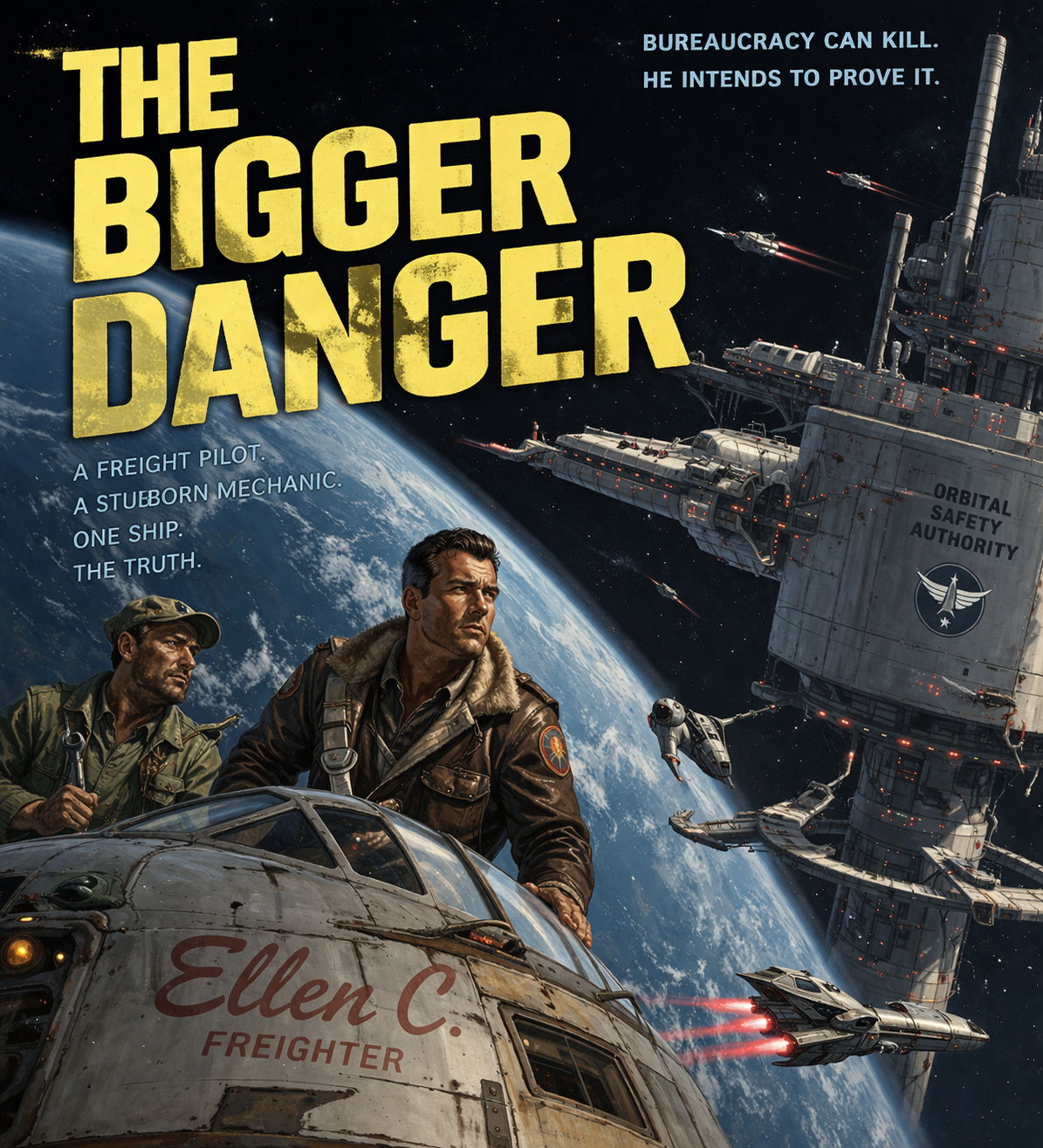 Albert Jennings had been warned about the way things were going long before he paid any attention. That is the trouble with warnings. Most of them arrive before a man has enough data to know whether they are wisdom or just old talk fermented into certainty. Jennings had heard them in dockside cafés from retired tug masters, from cargo handlers with radiation freckles on their hands, from women who had spent their youth in the first hotel wheels and now sold insurance to fools. Always the same tune: too many rules, too many forms, too many uniforms, too many men who had never ridden a hard burn making decisions for those who did. Jennings had always shrugged. Regulations were weather. You cursed them, worked around them, and kept your manifolds warm. He was thinking exactly that when the trouble started. His ship, the *Ellen C.*, was not pretty. She had been pretty once, perhaps, in the way a riveted pressure kettle may be pretty on the day it leaves the factory. But twenty-two years of freight work between Earth and orbit had cured her of any vanity. Her hull wore patches from a dozen different yards in three different shades. Her port radiator panel bore a scar where a micrometeoroid had punctured it over Quito. The pilot couch had been reupholstered twice and still smelled faintly of burned insulation whenever the cabin heater kicked on. But she was honest, and Jennings preferred honesty to beauty in machines. He was dropping out of transfer toward Bernal Three with six tons of machine tooling, forty cases of freeze-dried eggs, two crates of violin varnish, and a diplomatic pouch he had not asked about, when Traffic Control ordered him into a holding spiral. “Freight vessel *Ellen C.*, reduce vector by two point three meters per second and enter stack lane Delta-Seven.” Jennings touched the comm stud. “Control, this is Jennings. Delta-Seven puts me behind four liners and a livestock tender. I’m on a tight slot at Dock Seven.” “Authority directive. Traffic density.” Jennings looked at his board. Density, his eye. The plot was as thin as a poor man’s stew. Plenty of room. He keyed again. “I’ve got clear approach to Seven right now.” There was the smallest pause. It was not enough to mean much, unless you had spent half your life listening to people hide behind procedure. Then the voice came back, clipped and official. “Negative, *Ellen C.*. Proceed Delta-Seven. Failure to comply will trigger administrative penalty.” Jennings bared his teeth, though nobody could see it. “Always happy to cooperate with civilization.” He took the delay. A freelance pilot learns where pride pays and where it merely runs up fuel costs. Three minutes later, the emergency started. A mayday burst onto the channel, raw and frightened. A shuttle inbound from Clarke Transfer was reporting steering failure and tumble. Then every circuit lit like Christmas in a gambling town. Control barked instructions. Rescue boats were scrambled. Dock approaches sealed. Two liners were ordered to abort. Somebody in the stack was cursing steadily in Portuguese. Jennings cut thrust and watched the mess bloom across the plot. The failing shuttle slewed wide of Bernal Three’s outer spokes, missed a fuel barge by less than a cable, and finally got snared by a rescue tug with enough drama to sell subscriptions. Nobody died. That was the sort of miracle authorities later took full credit for. Jennings waited in the holding pattern for eighty-seven minutes. By the time he got berthed he was sour enough to etch metal. Bill Callaghan was waiting on the dock in oil-streaked coveralls and a cap that had once advertised Irish whiskey. Bill was short, bull-shouldered, and had hands like castings. He had kept the *Ellen C.* running through five owners, three bankruptcies, and one regrettable experiment with cheap Martian reaction valves. He regarded all authority as an engineering problem: if it made noise and reduced efficiency, it ought to be disassembled. “You’re late,” Bill said. Jennings climbed down the ladder. “Traffic density.” Bill snorted. “That what they’re calling staged panic this week?” Jennings stopped halfway to the dock deck. “What?” Bill scratched his chin with a wrench. “You hear me.” Jennings looked at him. Bill seldom wasted words, and never on drama. “You know something?” “I know,” Bill said, “that shuttle that lost steering didn’t lose steering.” That got Jennings all the way down the ladder. Bill jerked his head toward the maintenance corridor. “Come on.” Bill’s rented bay was tucked behind the public service lockouts, where honest labor hid from inspectors. The walls were lined with bins, tools, stripped pump housings, and enough contraband spare parts to arm a small rebellion against bad design. On the workbench sat a guidance module no bigger than a lunchbox, cover off, guts exposed. “Recognize it?” Bill asked. Jennings leaned in. “Standard Authority-certified shuttle attitude controller.” “Certified by saints and blessed with paperwork,” Bill said. “Came off the mayday boat.” Jennings straightened. “How’d you get that?” Bill gave him a patient look. “Because people owe me favors and because half this station runs on parts the Authority says are obsolete but still works fine if you don’t have the brains of a committee.” He tapped a blackened relay. “That burned?” Jennings said. “Nope.” “It looks burned.” Bill nodded. “Cosmetic scorching. Factory-applied.” Jennings looked again. He had learned long ago that Bill’s first answer was usually the beginning of the lesson, not the end. Bill pointed with a scribe. “This relay assembly is modified. Not enough to show on routine scan. It accepts an override pulse on a maintenance frequency no shuttle pilot ever touches. You hit that pulse, controller dumps orientation, screams failure, and leaves the crew thinking God Himself pulled the wires.” Jennings said nothing. Bill went on, “Somebody wanted that shuttle to look sick without actually killing it. Timed it neat, too. Close enough to the habitat to jam traffic, far enough to justify rescue.” Jennings looked at the open module, at the false scorching, at the unauthorized wire bridge Bill had exposed with a knife tip. “That’s a prison-grade charge if you’re right.” “If I’m right?” Bill said. “Al, I could prove this to a blind man by letting him hold the solder.” Jennings sat down on an overturned crate. Most dangerous lies are not the grand kind. They are the practical sort, the ones that explain an inconvenience and then ask for a little more authority to prevent its return. The Orbital Safety Authority had been asking for more authority for years. More route control. Mandatory remote override packages. Expanded inspection powers. Licensing reviews. Emergency jurisdiction over private docks. It was all sold as necessary, regrettable, temporary, and for everyone’s protection. And every fresh emergency made the speeches easier. “You told anybody else?” Jennings asked. “Not yet. Told you first because you own the ship and I need somebody reckless enough to use it.” “Flattering.” “It’s not flattery if it’s a materials specification.” Jennings rubbed his face. “Suppose we go to the station marshal.” Bill stared at him. “And tell the station marshal that the Authority, which audits the marshal’s docking compliance, is sabotaging shuttles to win political arguments?” “When you put it that way.” “I do.” Jennings stood up again. “What do we need?” Bill’s mouth twitched. On Bill, that counted as enthusiasm. “We need proof that’s bigger than one module. Records. Hardware. A pattern. Something the Authority can’t bury as a rogue technician and a tragic misunderstanding.” Jennings looked at the bay door, past it to the station beyond, where announcements would already be playing about swift official response to today’s regrettable incident. “A pattern,” he repeated. “Exactly.” Jennings sighed. “That means trouble.” Bill nodded. “Real trouble.” “Fine,” Jennings said. “I was getting tired of eggs.” The first favor Jennings called in belonged to a woman named Marta Velez, who ran manifests for three docks and knew more about cargo movement than any algorithm paid too much to fail elegantly. Marta believed in three things: accurate records, expensive shoes, and reciprocal obligation. Jennings had once carried antibiotics to her brother’s mining concession ahead of a dust storm. She had not forgotten. They met in a coffee house spun into the station’s inner curve, where the floor sloped gently enough to keep visitors uneasy and regulars comfortable. Marta listened without changing expression, which on her was a sign of attention, not indifference. “You’re asking me,” she said finally, “to search restricted incident traffic and maintenance transfers involving the Authority.” “I’m asking you,” Jennings said, “whether emergency shuttles that conveniently fail have a habit of routing through the same hands.” She stirred her coffee. “That’s a poetic way to commit conspiracy.” Bill said, “We can use shorter words if it helps.” Marta ignored him. She looked at Jennings. “Al, if I do this and it’s smoke, I lose my position.” “If you don’t do it and it’s true, you may lose more than that.” Marta considered him for another moment, then nodded once. “I’ll look.” She did better than look. Twenty hours later she sent a dead-drop packet to the *Ellen C.* with six incident summaries, two maintenance contractor lists, and a note: *You are either very unlucky or very correct.* The six incidents stretched over fourteen months. A tug that lost collision radar approaching Nairobi Ring. A life-support alarm on a commuter spindle. Two “sensor blooms” that forced traffic freezes. A guidance dropout on a survey launch. The shuttle yesterday. In each case the public explanation had been equipment fault, rapid official response, no systemic cause for concern. In each case the affected component had passed through a refurbishment contractor called Helix Systems Compliance. Bill whistled through his nose. “There’s your pattern.” Jennings frowned at the name. “Helix. I’ve seen that.” “You have,” Marta said over the secure line when Jennings called her back. “Helix does retrofit work for Authority-certified safety packages. Small company. Quiet company. Three directors, all with prior Authority postings. One current contract bid pending for expanded emergency override installation on independent freight vessels.” Jennings leaned back in the pilot seat. “There it is.” “There what is?” “The profit motive, dressed in public service.” Marta did not disagree. “Be careful. Once you see the skeleton, you start noticing how many uniforms it is wearing.” That same evening, Jennings got his first warning. He was walking back from dock customs when two Authority inspectors stopped him at a corridor choke point. Their uniforms were immaculate, which is always suspicious in men who claim to work around machinery. “Pilot Jennings,” said the taller one. “Routine compliance interview.” “I’m touched.” The man showed no sign of humor damage. “Your vessel’s emergency beacon registry contains a discrepancy.” “It does not.” “We would like to escort you to an office and clarify the matter.” Jennings looked from one to the other. The corridor behind him was empty. “Then clarify it here.” “Procedure requires—” Jennings moved before the sentence finished. Not because he was fast, but because he was experienced. There is a difference. Fast men trust speed. Experienced men trust timing. He shoved the taller inspector into his partner, drove through the gap, and ran. No romance attaches to middle-aged men running in station corridors. There is no poetry in a freight pilot wheezing past a vending alcove while two government clerks bellow behind him. But Jennings knew the maintenance ways better than the inspectors knew their own regulations. He cut through a gravity transition, vaulted a handrail, and ducked into an access lock marked CLOSED FOR FILTER WORK. Bill opened the inner hatch with a pneumatic driver in one hand. “You look winded,” Bill said. “They wanted to clarify me.” Bill sealed the hatch. “That quick, eh?” “That quick.” Bill nodded without surprise. “Good. Means we’re onto live current.” The second favor came from Earth. Professor Hannah Greer had once been chief systems analyst for the Authority before resigning in a published storm of letters about “centralized risk amplification through bureaucratic reflex.” The Authority had dismissed her as alarmist. Since then she taught orbital governance law at Columbia and irritated influential people for sport. Jennings reached her on a narrowbeam link at some cost in bandwidth and patience. Her face appeared on the screen sharp as broken glass, silver-haired and alert. “Albert Jennings,” she said. “Still underinsuring your cargo?” “Professor, I need to know how emergency directives get justified internally.” She listened to the short version and did not once ask whether he was certain. Jennings respected her immediately for that. “At the policy level,” she said, “the Authority has been seeking mandatory remote compliance packages for all independent traffic for three budget cycles. Opposition has come from private carriers, habitat councils, and insurers. The sticking point has been necessity. Their data did not show enough unmanaged emergency risk.” “And now?” “Now it does, I expect.” Jennings exchanged a glance with Bill. Greer went on. “You are describing a manufactured data environment. It would not require vast conspiracy. Only a few men at the points where incident classification, equipment certification, and emergency recommendations intersect. That’s the elegant vice of bureaucracy. It can do immoral things with excellent filing.” “Can you prove any of it?” Jennings asked. “From Earth? No. But if you find internal incident coding or contractor authorization linked to policy recommendations, I can make enough public noise to keep them from burying it quietly.” Bill leaned toward the screen. “How much noise?” Greer gave him a cold smile. “Young man, I have tenure.” Bill grinned. “I like her.” “I heard that,” Greer said. The problem with proof was where it lived. Helix Systems maintained a service platform attached to an old fuel truss half a kilometer off Bernal Three’s commercial hub. Nothing dramatic: a stripped-down maintenance spider with three pressurized modules and a hardware store’s worth of antennae. Officially it handled calibration, refurbishment, and emergency systems verification. Unofficially it was where Jennings and Bill now suspected the poison entered the bloodstream. No court would issue them a warrant. No honest official would survive asking the wrong questions. So Jennings did what practical men have always done when institutions become too well-armored for decency: he improvised. The *Ellen C.* declared a coolant imbalance and requested emergency servicing. Bill made the imbalance real enough to survive casual inspection without actually endangering the ship. Jennings hated that part, but a con is like surgery. Done gently, it fails. Helix accepted the service request. Independent freight boats were good revenue, and the Authority’s pets seldom expected customers to bite. As the *Ellen C.* drifted into the service frame, Bill muttered, “You still have time to decide this is stupid.” “It was stupid yesterday.” “It has matured since then.” Jennings brought them to dock with the patient touch of a man who had spent enough years in vacuum to mistrust any motion he did not personally start. Helmeted techs swarmed the hull. One service supervisor came aboard with a tablet and a smile that had been trained not to wrinkle. Jennings played the irritable pilot. Bill played the surly mechanic, which required no acting at all. While the supervisor argued projected labor time, Bill slipped out through the engineering crawlway into the service junction. He carried a tool satchel containing exactly half tools and half burglary. Jennings kept the supervisor talking with questions about certified replacement stock, turnaround guarantees, and whether Helix was really charging triple rate for gasket work because the Authority had recently updated some line in a procedural booklet. The man defended policy. That took almost twelve minutes, which was longer than Bill needed. The first sign trouble had ripened came from the intercom. “Supervisor Kline to service deck. We have an unauthorized terminal access in Archive Two.” The supervisor on the *Ellen C.* went pale in a professional way. Jennings hit him once, neatly, with the portable oxygen bottle he had been holding for emphasis. The man folded without any poetic last words. Jennings sealed the cabin and sprinted aft. Bill came through the engineering hatch at a dead run, face slick with sweat, satchel bulging oddly. “Undock now.” Jennings needed no further briefing. He threw himself into the couch, snapped restraints, and lit the board. Alarms howled across the link gantry. External clamps tried to hold them for a tenth of a second, then Bill’s earlier “coolant problem” vented into the right places and confused the servos enough to free them. The *Ellen C.* backed out crooked, kissed a service boom with her stern, and went hard to port on maneuvering jets. Somebody on Helix control shouted about piracy. Somebody else shouted for Authority interceptors. “Did you get it?” Jennings barked. Bill strapped in beside him, hugging the satchel. “I got something.” “You don’t sound sure.” “I’m an honest man under stress.” Two interceptors launched from the habitat before Jennings had cleared the service zone. They were sleek little Authority darts with enough thrust to make a freight hauler look like theology. Jennings did not bother trying to outrun them. Space is not atmosphere. There are only so many tricks. But there are always some. He cut for the construction lanes where unfinished trusswork drifted under beacon control. It was technically forbidden. That made it useful. The interceptors followed, naturally, because official confidence is often strongest where prudence would advise hesitation. “Bill,” Jennings said, “talk to me.” Bill had a pad jacked into the satchel’s prize: a data core the size of a legal code and probably twice as sinful. “I copied archive snapshots before they chased me,” Bill said. “Maintenance logs. Incident tags. Internal memos if the indexing isn’t lying.” “Anything good?” “Define good.” The first interceptor ordered him to cut thrust and prepare remote immobilization. Jennings laughed once, harshly. “There it is.” “Remote what?” Bill said. “Exactly.” The *Ellen C.* shuddered. One of the darts had locked into his certified emergency receiver and was trying to seize partial control authority over his guidance bus. The package had been mandatory for six months on all licensed freight. Bill swore with heartfelt inventiveness. “Kill it.” “I can’t. It’s in the safety spine.” Bill yanked open the panel under his couch. “Then I can.” The second interceptor came around the unfinished truss and overshot because its pilot had more confidence than geometry. Jennings threaded the gap between two skeletal ring segments with twelve meters to spare. Bill vanished shoulder-deep into the access well, sparks coming out around him. “Al,” he said, voice muffled, “when I cut this, your board is going to look like Judgment.” “It looks like that now.” “Fair.” He cut it. Every safety light on Jennings’s panel came on at once. Half the board died. The remote override dropped out. The *Ellen C.* became, for three or four memorable seconds, a badly behaved brick with delusions. Jennings held her by hand. People who write about ships usually enjoy saying that a vessel becomes an extension of the pilot. It is prettier than the truth. The truth is that under strain a ship becomes a problem set too fast to write down. Jennings did not merge with the *Ellen C.*. He wrestled her, bullied her, guessed at her temper, and stayed ahead of her mistakes by a margin no thicker than luck. They blasted clear of the truss, dove under Bernal Three’s lower communications fan where interceptors would hesitate to fire or ram, and got three precious minutes of no clean shot. Bill hauled himself back into the seat, clutching a wire bundle like a trophy from mechanical war. “I hate modern design,” he said. “Did we lose anything important?” “Only everything bureaucrats call important.” “Good.” Bill stared at the data pad. Then his eyes widened. “Al.” “What?” “I’ve got incident classification tables. Cross-linked to policy recommendation packets.” “English.” Bill swallowed. “Every emergency event gets coded for severity, public impact, and regulatory leverage.” Jennings turned his head. “Leverage?” Bill looked sick now, which on him was rare and instructive. “That’s the word. Regulatory leverage. There are notes. ‘High visibility opportunity.’ ‘Supports expansion case for centralized intervention.’ Al, these bastards scored emergencies by how useful they’d be in hearings.” Jennings felt something cold settle into him. That was the proof. Not the sabotage alone. Sabotage could be blamed on rogues. Not the contractor ties alone. Those could be regrettable overlaps. But the language of the machine itself—that was harder to excuse. Men may lie. Institutions write down their sins in jargon and call them workflow. “Can you send it?” Jennings asked. “Not yet. Need a clean beam. Need redundancies.” “Do it.” They could not go back to Bernal Three. They could not go to any official relay. Jennings took the *Ellen C.* out toward a private ore-processing spindle whose owner owed him money and did not much care who annoyed the Authority so long as it happened elsewhere. From there they sent the archive in six encrypted bursts: one to Professor Greer on Earth, one to Marta, one to three independent news services hungry enough to verify before asking permission, and one to the insurer consortium that had been fighting the Authority’s latest control proposal on cost grounds. Money and scandal are natural predators of one another. Jennings had learned that too. Then they waited. The Authority issued its first statement forty minutes later, calling circulating materials “maliciously altered technical fragments connected to an active smuggling investigation.” That might have worked in quieter times. It failed because Greer was already on every serious feed explaining exactly what “regulatory leverage” meant in plain language sharp enough to draw blood. It failed because Marta had leaked corresponding manifest data showing incident clustering around Helix-refurbished hardware. It failed because one of the insurers, seeing profit in honesty for once, publicly suspended cooperation with Authority override mandates pending criminal review. And it failed because Helix’s own deputy systems manager, a tired man with two school-age daughters and apparently a conscience that had finally achieved ignition temperature, went on record before dawn and confirmed the archive was genuine. By noon Earthside, habitat councils were demanding hearings. Dockworkers marched under signs nobody had professionally lettered. Private pilots began physically disconnecting certified remote packages from their ships in numbers too large to police. Three Authority officials resigned. Two more took medical leave. The director of emergency operations appeared before cameras looking like a man who had trusted paperwork to keep its box closed and was now learning otherwise. Jennings watched it on the galley screen while drinking terrible station coffee and trying to feel victorious. Bill sat opposite with his boots on a crate of replacement filters. “Well,” Bill said, “we kicked over the anthill.” Jennings nodded. Bill squinted at him. “You look unhappy. That isn’t like a man in possession of vindication.” Jennings turned the cup in his hands. “Because it doesn’t fix the thing itself.” Bill waited. Jennings said, “You can expose a racket. Fine. You can even jail a few men if the public is in a moral mood. But give it a year, five years, ten. Another authority will grow where this one stood. They always do. Fear is fertile ground.” Bill scratched his jaw. “That true.” “And space is dangerous,” Jennings said. “That’s the damned advantage they have. Vacuum is real. Radiation is real. Bad bearings are real. So a man says he’ll protect you from all that, and pretty soon he wants your keys, your routes, your ship, your right to judge your own risks.” Bill leaned back. “Then what?” Jennings looked at the screen, where some earnest commentator was saying this proved the need for stronger oversight of safety authorities. He laughed then, really laughed, because the universe appreciates symmetry and sarcasm in equal measure. “Then,” he said, “men like us keep flying. Keep watching. Keep refusing easy cages.” Bill pointed at him. “That’s almost noble. Don’t make a habit of it.” A chime came from the comm panel. Marta’s face appeared without waiting for permission, which was her way. “You two have become inconveniently famous,” she said. “Can fame pay docking fees?” Jennings asked. “No. But this might.” She transmitted a contract packet. “Emergency freight to Lagos Wheel. Medical fabrication gear. Priority bonus. The regular carriers are disrupted because half the Authority inspectors have been locked out by their own systems.” Bill cackled. Jennings opened the packet. The pay was obscene enough to feel respectable. Marta added, “Also, the hearing board wants testimony later this week.” Jennings grimaced. “I haul freight. I don’t testify.” “You do now.” The screen cut. Bill stood up. “Well, Al?” Jennings looked around the galley of the *Ellen C.* at the chipped table, the humming vent, the patched bulkhead panel Bill kept meaning to repaint and never would. Honest ship. Ugly ship. Free ship, at least for the moment. He set down the cup and rose. “Load the filters later,” he said. “We’ve got medical gear to haul and civilization to mildly embarrass.” Bill grinned. “That’s the spirit.” They cast off two hours later. Bernal Three turned slowly behind them, bright and fragile against the dark. Beyond it lay Earth, cloud-swirled and old. Beyond that, more stations, more routes, more men in offices drafting policies to improve the species by administrative means. There would be more fights. Jennings knew that. There would be more emergencies too, some real, some manufactured, some impossible to classify except by those who lived through them. But for the moment the board was steady, the cargo list was clean, and the *Ellen C.* was pointed at open space under her own command. Jennings put a hand on the thrust lever. “Bill.” “Yeah?” “Next time you tell me a relay only looks burned, ease into it.” “No.” Jennings smiled despite himself and lit the drive. The ship moved, and that was answer enough.
Comments