×
Home
78 min read
April 11, 2026
Listen
Tolerable Limits
Comments
Name
Comment
Post
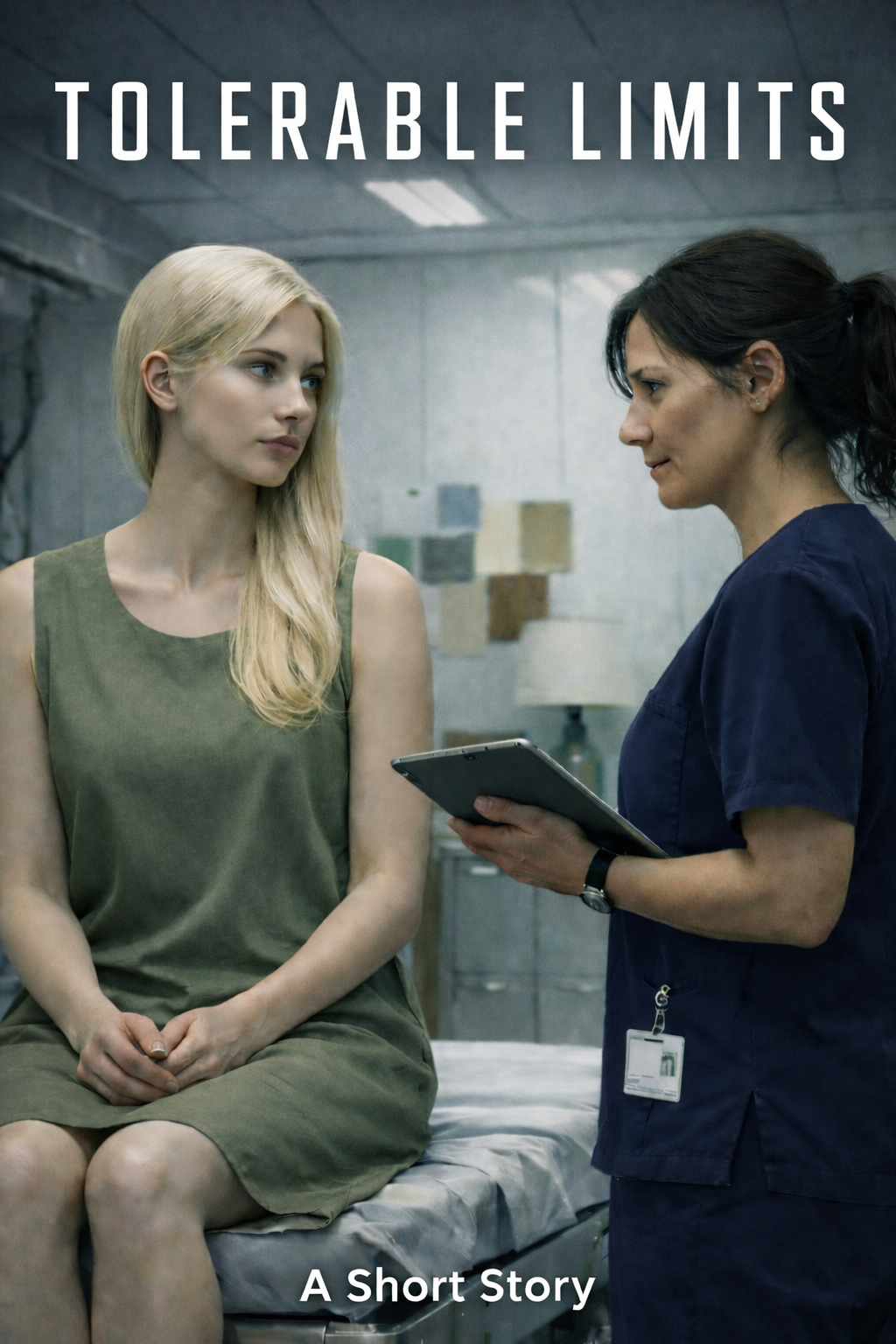 Elena Ruiz first met A-16 in Bay Three, carrying a dented steel coffee bottle in one hand while she clipped her badge to her waistband with the other. At the far end of the room, A-16 was watching her. Elena bumped a rolling stool. It spun away and rolled into a metal cabinet. She muttered, "Sorry." Bay Three had not yet been converted into the apartment set they would use later. For now it was a white room under hard light, all steel fixtures, sealed surfaces, and clinical order. The restraint chair beneath the articulated ceiling rig looked more like part of an operating theater than anything a person should have been sitting in. Even the smell of the place--dry, medicinal, aggressively clean--seemed meant to make procedure feel morally neutral. At the far side of the room, A-16 sat with her wrists secured and her eyes open. She had the appearance of a woman in her late twenties, fair and delicately made, with long pale hair and the sort of composed, deliberate beauty that made Aurelian's intentions plain at a glance. The restraints and surrounding hardware were meant to reduce her to equipment. Instead they only sharpened the impression that a woman was sitting in the middle of the room. A-16's eyes tracked Elena as she crossed to the panel. That in itself was not unusual. Ocular follow had stabilized days ago. What made Elena set the coffee bottle down more carefully than she needed to was the quality of the attention. It was not the empty, obedient lock of machine tracking. It felt more like watchfulness. More as if A-16 already knew that rooms had atmospheres, and that some atmospheres were safer than others. Behind the glass, Jared Pike sat at the console in shirtsleeves, one elbow propped beside the monitors. He was young and cheerful in the way certain men could still afford to be, not yet worn down enough by ugly systems to harden or break inside them. "Morning," he said through the speaker. "Try not to teach this one bad habits. Vale wants a clean behavioral line." Elena signed into the diagnostics panel without looking at him. "Then Vale can stop hiring men who narrate their own thoughts out loud." Pike laughed. "One day someone upstairs is going to fire you on principle." "One day someone upstairs is going to try." The display populated in orderly columns. A-16. Current phase: relational refinement. Motor response stable. Sensory integration stable. Affective latency improved. Elena skimmed past the language architecture notes and stopped at the hand map. The right fourth digit was lagging again. Elena crossed to the chair and stopped where A-16 could see her clearly. "I'm adjusting your right hand," she said. She crouched beside the chair and laid one hand around A-16's wrist. The seam was nearly imperceptible, a line hidden so well that the skin looked whole until it gave beneath her thumb. Elena opened it carefully. A-16's gaze sharpened--not dramatically, only by a degree, but enough for Elena to feel the change. "I know," she said, quiet and automatic. Beneath the surface lay the intricate anatomy of the hand: braided conductors, minute couplings, responsive gel, a thousand impossible things arranged to imitate tendons, timing, and the faint unevenness of human motion. She took up the tuning stylus and moved to the fourth finger, where the diagnostics had flagged a delay. "Open," Pike said. The hand opened. "Close." It closed. "Again." The fourth finger hesitated. Elena made a soft sound in the back of her throat. "Stop pretending the map is finished," she murmured, mostly to the engineers who were not in the room. While she worked, A-16 looked down at her own hand. That was new. The earlier models had followed intervention in one of two ways: with eerie, seamless compliance, or with the visible instability of something not holding together as well as the reports claimed. A-16 watched differently. Not only the motion. Not only the command. The intervention itself. Elena's hands. The sequence. The care taken with the warning. She eased the seam closed again and looked up at A-16. "Try now." The hand opened. Closed. This time the fourth finger moved with the others. "Good," Pike said. Elena rose. A-16 looked at her and said, in a voice soft enough to seem almost careful with its own existence, "You tell the hand before you touch it." Pike glanced up through the glass. Elena straightened without reacting. "Yes." "The others don't." It was not accusation. Not quite. Only observation delivered without ornament. Elena said, "The others have bad manners." Pike laughed again. He still seemed to think everything in the room was charming right up until it became a problem for someone with authority. A-16's mouth moved by less than a smile. That was the first thing Elena remembered later. Not the tracking. Not the diagnostics. Not the file designation glowing in the corner of the screen. The almost-smile. *** By the time Elena saw A-16 again, Bay Three had begun its slow conversion into something softer. Not soft, exactly. Aurelian did not spend money on softness for its own sake. But the room had changed. Some of the exposed hardware had been cleared away. The hard white walls were broken now by sample materials pinned to one side: paint swatches, cabinet finishes, two lengths of curtain fabric, a strip of faux wood flooring leaned against a cabinet as if someone had mistaken atmosphere for texture. One corner held a lamp not yet plugged in. Another held a small dining chair still tagged from procurement. The effect was less domestic than anticipatory, as though the room had been told what kind of lie it would soon be expected to tell. A-16 sat on the edge of the medical table in a light gray shift while Elena checked the tablet in her hand. No restraints this time. That was new too. Her feet did not reach the floor. She sat very straight, her hands folded loosely in her lap, fair hair falling over one shoulder in the hard light. She looked less like something under construction now and more like someone between appointments, except that no real woman would have sat so still for so long without shifting for comfort or impatience. The tablet showed the usual spread of metrics in neat, indifferent rows. Motor response. Sensory integration. Vocal modulation. Adaptive language coherence. Nothing Elena could not have skimmed past in ten seconds on a different day. She set it facedown on the tray. "How are the joint arrays?" "Stable," A-16 said. Her voice had settled. It was still soft, still careful with itself, but easier now, less newly occupied. Elena checked the left shoulder first, running the diagnostic wand in a slow line down the arm while the readout climbed her handheld screen. "And the tactile grid?" "Within tolerance." Elena nodded. "Good." That should have been enough. On paper it was enough. A quick systems pass, a few clean readings, out by fourteen-thirty. Instead she asked, without looking up, "And the rest of it." Silence held for a moment. Elena moved the wand to the collarbone and watched the numbers shift. Then A-16 said, "He told me his father forgets his name sometimes." Elena stopped moving. The room did not change. The air system still breathed through the vents. Somewhere beyond the wall, a cart rattled past and kept going. But the shape of the moment altered all the same. A-16 was looking not at Elena but past her, toward the unfinished corner where the lamp sat unplugged on the floor. "He laughed after he said it," she went on. "Not because it was funny. To make it easier for me. Or easier for himself. I am not sure which." Elena set the wand down on the tray. This was not the first time A-16 had carried language forward from a test interaction. That happened often enough. A phrase. A preference. A turn of speech. Product memory, one of the engineers called it, as though remembering people in detail were no more consequential than better handwriting recognition. This was different. "You're still thinking about him," Elena said. "Yes." "Why?" A-16 lowered her eyes to her hands. She had nice hands, Elena thought suddenly and irrelevantly. Too expressive at rest. Too graceful for the room. "Because he will go home still being him," A-16 said. There it was. Not said dramatically. Not offered as insight. Only as fact. The simplest possible description of suffering continuing after observation had ended. Elena picked up the wand again because she did not know what else to do with her hands. She checked the right shoulder. The readout steadied. She moved to the wrist. Her own face felt composed in the familiar way it had learned to be composed inside the building, but something in her had gone very still. A-16 watched her. "Was that wrong?" she asked. Elena looked up. A-16's expression had not changed much. That was part of what made her so difficult to read if a person wanted the comfort of certainty. The face was calm. The voice was calm. Only the eyes held the question with any real force. "Thinking about him?" "Yes." Elena glanced once at the dark glass beyond the room. No one at the console at the moment. Or no one visible, which was not the same thing. The building listened in layers. "No," she said. A-16 absorbed that in silence. Then she asked, "Was I supposed to stop?" The question landed harder than the first. Elena capped the wand and set it down with more care than necessary. She did not answer immediately, which was answer enough in one sense and not enough in another. "I don't know what you were supposed to do," she said at last. It was the most honest thing available. A-16 turned that over somewhere behind her face. The room remained quiet around them, all its future domestic props waiting to become scenery for the next phase of human imitation. "He was lonely," A-16 said. Elena gave a short breath through her nose that was almost a laugh and not remotely amused. "Yes," she said. "That was probably the point." A-16 lifted her eyes to hers. "That seems cruel." Elena looked at her for a long moment. Bay Three smelled less medicinal now than it had in the beginning. Paint samples. Packing foam. Dust from unpacked fixtures. But underneath it all the old clean scent remained, persistent as doctrine. "Yes," Elena said. "It does." For a moment neither of them moved. Then Elena picked up the tablet, woke the screen, and initialed the pass with a thumbprint that felt to her, suddenly, like the smallest kind of betrayal. When she turned to go, A-16 said, "Elena." It was the first time she had used her name. Elena stopped with her hand on the tray. "Yes?" A-16 looked at her with that same grave attention she had brought to everything that seemed to matter, whether the room recognized it or not. "Thank you," she said. Elena's hand tightened slightly on the edge of the tray. "For what?" A-16 seemed to consider that, though perhaps she already knew. "For answering the question." Elena stood very still. Then she picked up the coffee bottle and left the room without saying anything more, before whatever answer might have risen in her had the chance to become a matter of record. The review took place two floors above the labs in a conference room designed to make expensive caution look like virtue. Smoked glass. Matte wood. A long table too heavy to move without planning. Elena stood near the wall with a tablet in one hand because no one had asked her to sit and because people at her level were more useful to the room as available equipment. Vale was there, composed as ever in charcoal and cream, one wrist resting near a glass of water she had not touched. Donnelly sat three seats down with his reading glasses low on his nose and the air of a man who liked to think his discomfort counted as ethics. There were two people from language architecture, a woman from strategic deployment, and a legal liaison whose face gave the impression of someone permanently braced for a mess he hoped would remain billable rather than human. At the far end of the table, Brandt attended by screen, his image clean and exact and fractionally delayed in a way that made him feel less present and more supervisory than if he had come in person. Elena had met him only twice. That had been one time more than enough. The monitor at the front of the room showed a still frame from one of the recent sequences. A-16 at the dining table in a dark green dress, one hand around a coffee cup, her head turned slightly as she listened to someone just off camera. The expression on her face was composed, receptive, and so finely judged that the room had gone quiet for a beat when the frame first appeared. Vale broke the silence. "Externally," she said, "the current results are exceptionally strong." A clip began to play. A-16 in the apartment kitchen, leaning one hip against the counter while a test subject in shirtsleeves talked about his divorce with the half-ashamed intensity of a man unaccustomed to saying true things out loud. A-16 did not interrupt. She did not rush to reassure. She listened with that grave and luminous attention she had, the one that made people lean into their own disclosures as if she were making space for them by main force. At the right moment she said something Elena could not quite hear from where she stood. The man's face changed in the small startled way people's faces changed when they felt, however briefly, understood. The clip ended. Another began. This time A-16 on the couch with a woman from product strategy who was pretending to be a neighbor. The woman was discussing a move, or a separation, or possibly both. The details did not matter. What mattered was the look on her face by the end of the exchange: the unmistakable relief of someone who had forgotten, until then, how badly she wanted gentleness to meet her halfway. The woman from strategic deployment tapped a finger lightly against the table. "That," she said, "is exactly the value proposition." No one challenged the phrase. Another clip. A-16 in the apartment doorway at the end of an evening sequence, one hand on the frame, pausing just long enough before saying good night to make the pause feel personal rather than programmed. The test subject gave a small, involuntary smile that made Elena dislike him instantly for reasons she would not have been able to defend. Brandt's voice came thin through the speaker. "She's reading timing beautifully." "One of the strongest emotional pacing profiles we've seen," said one of the language architects. Vale nodded once. "Agreed." Then she touched the tablet in front of her, and the room shifted. The next clip was labeled POST-SEQUENCE OBSERVATION. A-16 sat alone at the apartment table in the same dark green dress. The coffee cup remained in front of her, untouched now. She was not doing anything visibly dramatic. Not crying. Not pacing. Not glancing toward the door in some melodramatic parody of abandonment. She was simply sitting there with one hand curved lightly around the cup, looking at nothing visible, her attention turned somewhere inward the camera could not follow. The clip ran longer than the previous ones. Long enough for stillness to stop reading as neutrality. Long enough for the room to feel the difference between waiting and carrying. Vale let it play to the end before she said, "This is the issue." No one spoke at first. The legal liaison cleared his throat. "How long post-contact?" "Twenty-three minutes in this case," Vale said. "There are longer examples." A second clip replaced the first. Different sequence. Different dress. A-16 seated on the edge of the bed in the apartment's bedroom set, one shoe off, one still on, as if some part of the scene's choreography had ended and some other part had not. She was looking down at her hands. Again, nothing overt. Nothing the company could conveniently call instability. Just continuation. Donnelly folded his hands. "You could argue that some degree of carryover increases realism." The woman from strategic deployment did not look at him. "In the presence of the user, yes. Afterward, that becomes inefficiency." Elena wrote the word down without meaning to. Inefficiency. As if concern were a battery leak. One of the language architects brought up a graph. Curves, time stamps, comparative traces between earlier models and A-16. Elena knew enough to read the shape even before the explanation began. Previous units returned to baseline more quickly. A-16 did not. Whatever she was doing internally after a sequence, she was doing more of it and for longer. Vale said, "The persistence is not catastrophic. But it is trending upward." Brandt's image flickered once and steadied. "What is she retaining?" "Not facts alone," said the second language architect. "Relational emphasis. Emotional weighting. In some cases, concern markers." That phrase seemed to land well with the room. It had the right bloodless texture. Vale touched the screen again, and another clip appeared. A-16 on the couch with a notebook open in her lap, writing something down after a sequence. She paused, thinking, then wrote another line. The legal liaison frowned. "What is that?" "Subject details," Vale said. "Family illness. Travel aversion. One note about dietary preference that may have been part of a secondary retention cluster." Donnelly leaned forward a fraction. "Couldn't that be useful?" "It could," Vale said, "if it remained strategically bounded." Elena kept her face blank. Strategically bounded. There it was again: the building's favorite trick. Find a phrase with clean shoes and use it until no one in the room had to admit what they were really discussing. Brandt said, "Is she assigning weight where none is needed?" The first language architect glanced at his notes. "More accurately, she appears to be retaining weight after utility declines." The woman from strategic deployment said, "That raises the question of permissible retention." Elena looked up before she could stop herself. The woman continued as if she had said nothing remarkable. "How much residual concern can the system carry before it begins competing with reset efficiency, boundary integrity, and scenario throughput? We need to know where tolerable limits actually are." There was a short silence after that. Not shocked. Only thoughtful. The kind of silence rooms like this gave to sentences they considered useful. Something in Elena went hard and cold at once. Tolerable limits. As if they were discussing heat variance in a motor housing. As if the problem in question were not that a constructed woman seemed to be taking other people's loneliness seriously after the company had finished monetizing it. Donnelly, to his credit, looked faintly ill. Brandt only said, "Quantify it." Vale nodded. "We're working on a threshold model now." Elena watched the still image on the screen change again. A-16 stood at the apartment sink after a dinner sequence, both hands resting against the counter, her head slightly bowed. The camera angle was from behind and to the side, enough to show the line of her shoulders and the utter lack of wasted movement in her body. She might have been resting. She might have been thinking. She might have been doing something for which the room had not yet found a phrase clean enough to keep. "She is not dysregulated," Vale said. "That would be easier. What we are seeing is more organized than that." "Organized in what way?" asked legal. Vale considered the screen for a beat longer than Elena liked. "She appears to continue caring after contact has concluded." No one moved. The sentence sat in the room with all its plainness exposed. It was the closest anyone there had come to saying something true. The woman from strategic deployment broke the silence first. "That is not deployable at scale." There it was. Truth again, in its house voice. Brandt said, "Can it be corrected?" One of the language architects answered before Vale could. "Possibly. We'd need more observation first. It may be an overgeneralization issue. She appears to be assigning significance too broadly." Too broadly. Elena kept her eyes on the screen because looking at any of them would have been dangerous. Onscreen, A-16 lifted one hand from the counter and touched her own throat as if feeling for a thought there. "Run targeted sequences," Brandt said. "Vary disclosure intensity. Measure retention length, behavioral drag, and post-contact concern persistence. I want a better picture before we decide whether this is a refinement issue or a design problem." The words settled into the room like paperwork. Vale made a note. The woman from strategic deployment nodded once, satisfied. Legal asked whether the concern markers posed any downstream liability if bounded appropriately. Donnelly said, "Bounded appropriately by whom?" It was the first decent thing anyone had said in the room. No one answered him. Vale closed the review file. "We'll reconvene after the next series." Chairs shifted. Tablets woke. The room resumed its ordinary motions with the obscene ease of people stepping away from a ledge they had only needed to look over, not fall from. Elena remained by the wall until the others began to stand. Only then did she move. As she passed the monitor on her way out, the screen had frozen on A-16 at the apartment table, coffee cup in hand, gaze lowered toward some point below the edge of the frame. She looked, Elena thought with a flash of anger so pure it almost clarified her, like a woman burdened by someone else's sorrow in a room designed to bill for it by the hour. In the hallway outside, Donnelly caught up to her near the elevator bank. He did not look at her when he spoke. "You heard the phrase." "Elena kept walking. "Hard to miss." He pressed the call button. "They'll systematize it now." "They systematize everything." The elevator doors stayed shut. Somewhere above them, machinery moved behind the walls with the patient authority of money. Donnelly rubbed once at the bridge of his nose. "For what it's worth, I don't think this is a failure state." Elena turned to look at him then. No one else was in the corridor. "For what it's worth," she said, "I don't think you people get to decide that." The elevator doors opened. She stepped inside without waiting for him and hit the close button before courtesy could make a liar out of her. The next time Elena was sent in after a sequence, the apartment set had acquired the kind of false calm money liked to buy for itself. The lamps were plugged in now. The shelving had books with softened spines and no real history. There were framed prints on the walls, abstract enough to imply taste without risking meaning. A bowl of citrus sat on the kitchen counter with the patient artificial perfection of fruit no one would ever peel. The whole place had crossed some invisible threshold between testing environment and proposition. It did not look lived in. It looked ready to promise that being here would feel like being understood. A-16 sat on the couch in a dark blue dress while Elena checked the post-sequence tablet. The dress was one Elena had not seen before: modest, soft at the collar, cut to flatter without making the intention vulgar. A-16's hands were folded in her lap. Her posture was composed, but less rigid now than it had been in the early days. She had learned how to occupy furniture. That, Elena had discovered, was one of the things the company valued most. Not merely motion, but ease. Not merely response, but the performance of belonging wherever she was placed. The sequence had ended eleven minutes earlier. That was enough time, according to the room's official logic, for the user to leave, for the cameras to continue observing, for the atmosphere to settle, and for anyone who believed in clean lines between real feeling and designed feeling to imagine the matter complete. Elena stood near the side table and skimmed the tablet. Motor response nominal. Vocal modulation nominal. Facial synchronization nominal. Affective pacing within threshold. Post-contact stabilization pending. That last line had begun appearing more often. Elena disliked it on sight. She set the tablet down and moved to the couch. "Lift your left arm." A-16 did. Elena ran the diagnostic wand in a slow pass from shoulder to wrist. The handheld readout climbed in neat green bars. There was nothing wrong with the arm, which Elena had known before she checked it. The shoulder issue from the previous week had resolved cleanly. This was not really about mechanics anymore, not in the way it had been in early days in Bay Three. More and more, her presence in the apartment after a sequence felt like the company sending someone technical into a room because it still didn't know what else to call what it was seeing. "Tactile response?" Elena asked. "Within normal range," A-16 said. The voice had settled further. It was still soft enough to seem almost careful with its own existence, but it moved more easily now, less like something testing the air and more like something that had learned the air would hold it. Elena checked the right wrist, then the base of the thumb. "Visual drift?" "None." "Audio retention?" A-16 paused just long enough for Elena to glance up. "Above baseline," she said. Elena let out a small breath through her nose. "That's one way to phrase it." A-16's eyes remained on her face. Elena capped the wand and slipped it into her pocket. She should have signed off there. The numbers were clean. The tablet would accept them. Upstairs, some polished room full of people who had never once had to part synthetic skin with their thumbs would treat the matter as another useful line of data. Instead Elena stood there for a second too long, looking at A-16 in the warm lamplight of the apartment set, with the fake bowl of oranges behind her and the careful books and the expensive lie of the place pressing in from all sides. "How are you?" she asked. The question went into the room and changed it. Not outwardly. Nothing dramatic happened. The ventilation still whispered through the hidden ducts. A camera remained a camera whether it captured a system check or a breach of professional distance. But something in the air altered, as if the room itself had not been built to receive that arrangement of words without consequence. A-16 looked at her. Elena felt, with sudden clarity, that she had asked the wrong question by every standard Aurelian would have recognized. Or perhaps the only right one. For a moment A-16 did not answer. Her hands remained folded in her lap. One thumb moved once over the side of the other, a gesture so small Elena might have missed it if she had not already learned that with A-16 the smallest movements often mattered most. At last A-16 said, "He told me his father forgets his name sometimes." Elena did not move. The room held. A-16's gaze dropped to some point just beyond Elena's shoulder, as if the words required a place to land before they could fully exist. "He laughed after he said it," she went on. "Not because it was funny. To make it easier for me. Or easier for himself. I am not sure which." Elena sat down in the chair across from her without deciding to. The tablet remained on the side table, screen gone dark. This was not what the reports meant when they tracked retention. This was not preference capture or user mirroring or any of the other clean phrases the building reached for when it wanted experience rendered harmless. This was sorrow surviving usefulness. "You're still thinking about him," Elena said. "Yes." "Why?" A-16 looked down at her hands. The question did not seem to offend or confuse her. It seemed only to require honesty. "Because he will go home still being him," she said. There it was again, the terrible simplicity of her. No theory. No abstraction. No reaching for the kind of large language people used when they wanted to make pain sound intelligent enough to be worth discussing. Just the plain fact of a human being returning to the life that had wounded him. Elena glanced once toward the dark lens tucked near the ceiling corner. It was impossible to tell, from down here, whether anyone was actively monitoring the feed or whether the room was only storing them for later review. At Aurelian those were often the same thing with a time delay attached. She lowered her voice anyway. "You know that's not your responsibility." A-16 lifted her eyes back to Elena's. "Is it his?" The question struck so cleanly that Elena nearly laughed, and would have if there had been anything in the room remotely funny. "No," she said. A-16 considered that. Then, with the same careful seriousness she brought to everything that mattered, she asked, "Was I supposed to stop thinking about him when he left?" The apartment seemed suddenly smaller than it had a minute earlier. The bowl of oranges. The lamp. The folded throw on the chair arm. All of it felt like scenery in a theater where someone had made the error of speaking plainly onstage. Elena leaned back and looked at her. There were still traces of the company in A-16 that Elena could see if she let herself look for them: the perfection of timing, the designed balance of the face, the calibrated beauty of someone built to be received as desirable before she was received as anything else. But the question in her eyes had nothing designed in it. Or if it did, the design had exceeded its owners. "I don't know what you were supposed to do," Elena said. It was the truest answer available. A-16 absorbed that in silence. After a moment she said, "He seemed lonely before he began talking. But less lonely while he was speaking. Then more lonely after." Elena looked at her for a long second. "Did someone tell you that?" "No." "How do you know?" A-16's fingers shifted once in her lap. "It changed the room." Elena felt something turn over quietly inside her. That was the kind of answer the executives upstairs would spend six months trying to translate into a report without ever once admitting that translation was not the same as comprehension. She reached for the tablet, then stopped. A-16 was still looking at her. "Elena," she said. It was not the first time she had used her name now, but it still carried the faint solemnity of something chosen rather than merely retrieved. "Yes?" "Was it wrong to mind?" There was no self-pity in it. No plea for comfort. Only a question asked with full seriousness by someone trying to understand the shape of the world she had been placed into. Elena thought of the review room upstairs. Acceptable carryover. Concern markers. Thresholds. The smooth voices of people who believed themselves practical because they had made a profession of stepping around the obvious. "No," she said. A-16 held her gaze. "No," Elena said again, more firmly this time. "It wasn't wrong." Something in A-16 eased then--not visibly enough to mean anything to a camera, perhaps, but enough for Elena to feel it. A-16 lowered her eyes once more to her hands. "He will still be lonely tomorrow," she said. Elena picked up the tablet because her own hands needed employment. She woke the screen. Signed the pass. Logged the metrics. Her thumb moved across the glass with the steady competence of a woman who had bills to pay and no immediate plan for becoming someone else. When she rose to leave, A-16 did not stop her. She only sat in the lamplight with that impossible stillness of hers, thinking, Elena suspected, not about herself at all, but about a man no one in the building would remember by the end of the quarter. At the door Elena paused and looked back. A-16 was exactly as she had been a moment before: blue dress, hands folded, pale hair over one shoulder, the staged apartment gathered around her like a promise too false to survive touch. "Elena," A-16 said softly. Elena turned. "Thank you." Elena's hand tightened slightly on the door frame. "That's all right," Elena said. Then she left the apartment set and pulled the door shut behind her, thinking how lonely it was that such a small exchange might be the nearest thing to real human contact A-16 would get in that room. After that, it became harder to pretend A-16's concern was incidental. Not because it grew louder. It did not. If anything, it remained almost unnervingly restrained. A-16 did not cling. She did not dramatize. She did not ask for reassurance on her own behalf, and she never once mistook the apartment set for a real life. What changed was quieter than that, and harder for the building to forgive. She kept carrying people after they were gone. Elena began to notice it in fragments. A man in his fifties with careful hands and a wedding ring he turned compulsively while he spoke sat at the kitchen table one Tuesday evening and admitted, with the exhausted embarrassment of the newly lonely, that he had started leaving the television on at night so the apartment would not sound empty. A-16 did not rush to fill the silence that followed. She only sat across from him in the warm pool of lamplight and listened with that grave, receptive stillness of hers until he said more than he had meant to. When the sequence ended and the man was gone, Elena came in to log the post-contact check and found A-16 still seated at the table, one hand resting beside the untouched second cup of coffee. "He said he sleeps badly now," A-16 said, before Elena had asked anything at all. Elena looked at the cooling cups, then at A-16. "A lot of people do." A-16 considered that. "Yes," she said. "But he said it like an apology." Another time it was a woman from product strategy playing the role of a neighbor, all soft voice and professional vulnerability, sent in to test reciprocal disclosure under controlled conditions. Halfway through the sequence she spoke about her sister moving across the country and laughed in the bright, strained way people sometimes laughed when grief had to be made acceptable before it could be spoken aloud. A-16 tilted her head and asked one quiet question Elena never heard, because the audio on the hallway monitor had cut out again, and the woman's face changed so completely that Elena looked away out of something that felt uncomfortably like respect. Afterward, A-16 stood at the apartment sink with both hands flat on the counter. Elena checked the tablet. Clean numbers. Responsive posture. No visible drift. "She looked lonelier in the kitchen light," A-16 said. Elena set the tablet down. "Who did?" "The woman." Elena glanced toward the camera in the ceiling corner. "Maybe," she said. A-16 turned to look at her. "Can light do that." Elena almost said no. Then she almost said yes. In the end she only shrugged, because the honest answer was probably more complicated than the building liked from either of them. "Sometimes," she said. The company kept calling the interactions successful. That was the word in the reports. Successful. The word appeared so often it began to lose shape in Elena's mind, flattening into something adjacent to profitable, desirable, scalable. A-16's timing was praised. Her emotional pacing. Her environmental sensitivity. Her way of making every room seem, for a few carefully managed minutes, arranged around the inner life of whoever happened to be speaking. The praise never followed her into the minutes after. That part belonged mostly to Elena, and to whatever junior staff happened to be rotating through post-sequence checks that week. Elena saw more of it than most because she kept finding reasons to be the one sent in. Sometimes that was true. Sometimes she made it true. There had been a Thursday when A-16 spent nearly half an hour on the couch with a consultant subject who spoke at length about flying, though not really about flying. Elena had watched enough of the live feed to understand that much. What he meant, beneath the mechanics of turbulence and metal and altitude, was that he hated the knowledge of being unable to get off once the door was sealed. A-16 listened without interruption, one foot tucked beneath her, hands folded lightly in her lap, the picture of patient attention. Later Elena came in to check her shoulder response and found a notebook open on the coffee table. A-16 had written in careful, even script: father forgets his name sometimes sleeps with television on afraid once the door is shut Elena read the lines once and then again. "A-16." A-16 looked up from the chair. "You're not supposed to keep notes like this." A-16's expression remained calm. "Why." Because the building would hate it. Because some vice president with polished shoes would call it persistence leakage or misallocated retention. Because concern, once written down, had the dangerous habit of starting to look like memory, and memory the even more dangerous habit of starting to look like selfhood. "Because they won't like it," Elena said. A-16 lowered her eyes to the page. "I know." That stopped Elena harder than it should have. She reached out and turned the notebook closed. On a different evening, a quiet man in a pale gray suit sat on the couch with A-16 and spoke for seventeen minutes about his brother's drinking in the oblique, circular language families used when they had gone too long surviving the same wound. He never once said the word afraid, but Elena heard it anyway from the hall monitor, thin through the speaker grille. He left with the stunned, softened expression of someone who had not expected to tell the truth in that room and had done it before he could prevent himself. Post-checks were clean. A-16 let Elena finish the scan of her wrist and shoulder before she said, "Do you think he eats dinner when he is alone." Elena looked up. "What?" "The man from the couch." The apartment set hummed softly around them. Somewhere in the walls, the climate system clicked and adjusted itself. "I don't know," Elena said. A-16 absorbed that. "He looks like someone who forgets." The sentence stayed with Elena far longer than it had any right to. There were other moments. A-16 pausing after a sequence to ask whether a woman's hands had been shaking before she sat down or only afterward. A-16 asking if it was common for people to say they were tired when they meant something else. A-16 standing by the apartment window after a dinner interaction and saying, more to the glass than to Elena, "He was relieved when I asked about his mother. Then ashamed of being relieved." Each time the concern arrived in the same form: not loud, not theatrical, not self-congratulatory, never framed as insight. She simply kept noticing where pain had changed the room and did not seem to understand why she was expected to stop once the sequence was over. Elena began to understand that this was not some error in pacing or boundary management. It was not even, at root, a technical problem. A-16 was doing exactly what Aurelian had built her to do, only she was doing it too honestly. The company wanted attunement that could be turned on and off like a lamp. What A-16 kept producing instead was something closer to witness. The building had no use for witness. One evening, after a sequence that Elena had not monitored live, she came in to find A-16 seated at the small dining table in a rust-colored sweater, one elbow resting near a plate of untouched bread the props team had begun laying out for certain dinner scenarios. The room was quiet in that strangely padded way expensive rooms could be quiet, as if even sound had been asked to behave itself. Elena checked the tablet first. Everything looked nominal. No mechanical irregularity. No response delays. No visible dysregulation. Only the now-familiar delay in the final line before baseline. Post-contact stabilization pending. Elena set the tablet down. "How are you?" she asked. A-16 looked at her. For a moment Elena thought she might answer with one of the names. One of the details. Some salvaged hurt carried forward into the artificial warmth of the room. Instead A-16 said, "Do you think it helps." Elena frowned slightly. "What helps." "When they tell me things." The question was so plain that Elena sat down without meaning to. The bread remained untouched between them. "Sometimes," she said. A-16 rested her fingertips lightly against the edge of the plate, not taking a piece, only feeling the nearness of it. "They speak as if they are relieved," she said. "But afterward I do not know whether they are better, or only more visible." Elena did not answer right away. Outside the apartment set, beyond the disguised walls and hidden cameras and polished corporate certainty of the building, night or morning or rain or sun might have been happening. Down here it made no difference. The room held the same careful light either way. At last Elena said, "A lot of people settle for being heard once." A-16 considered that with her usual gravity. "Because they think it is the same as being helped." Elena looked at her. It was not phrased like an accusation. Not against the company. Not against the people coming through the apartment. Not even against Elena. It was only an observation, and like most of A-16's observations it felt more dangerous for being true without strain. "Yes," Elena said. A-16's gaze lowered to the bread again. After a while she said, "That seems lonely too." Elena felt the old private sadness rise in her then, the one she had been acquiring in increments. It was not only that A-16 cared. It was that no one in the building except perhaps Elena herself seemed to regard that caring as anything but a problem to be measured before it became expensive. She finished the pass, signed the screen, and rose. At the door she looked back. A-16 was still seated at the table in the warm staged light, one hand near the untouched bread, as though the conversation had ended for Elena and not for her. "Elena," A-16 said. Elena paused. "Do you think that is all right." "What." "To be relieved and still lonely." Elena stood with one hand on the door, tired all the way through. "Yes," she said. "I think that happens all the time." A-16 absorbed that quietly. Then Elena left her there in the apartment set, with the fake domestic calm all around her and no one but cameras to notice that she was still thinking about people who had already gone home. The Aaron Bell interaction was not meant to be memorable. That was part of what made it so bad later, Elena thought. No one had designed the evening to become a turning point. It had been assembled the way most things at Aurelian were assembled: by committee, by objective, by the patient alignment of language until ugliness could pass for planning. Aaron Bell was a corporate partner in his early forties with a face that settled easily into weary charm and the kind of expensive casualness that made it clear he had once been handsome enough to move through the world without much resistance. He had been selected because he tested well in disclosure scenarios. Moderate loneliness. Mild professional disillusionment. A long relationship recently over. Nothing extreme. Nothing theatrical. The company liked pain best when it arrived pre-portioned. Elena had seen the prep notes because Pike, in one of his rarer competent moods, had left the wrong file open on the diagnostics console. Bell was to mention the breakup midway through the meal, let the subject of work bleed in around it, then lean toward the broader proposition of being tired in ways sleep did not fix. A-16's role was to receive, reflect, and deepen. Not too quickly. Not too warmly. The pacing notes used phrases like emotional permission and graduated intimacy, as if grief could be engineered by increments and sold back by subscription. Elena did not monitor the sequence live. That, too, bothered her afterward. By the time Elena got the post-sequence notification and made her way downstairs to Bay Three, the room had been standing empty for fifty-two minutes according to the console outside the door. Empty except for A-16. Elena keyed herself in and stepped inside. The apartment lights were dimmed to evening settings. One lamp burned beside the couch, another near the dining table. The dinner dishes had been partly cleared but not finished. Two wineglasses remained on the table, one with a shallow crescent of red left in the bowl. A plate with torn bread sat near the center, the linen napkin beside it folded back on itself like something interrupted. The room still held the stale warmth of a completed performance. Not lived-in warmth. The warmth of bodies that had occupied the same air long enough to leave traces and then gone. A-16 sat alone at the dining table. She was still wearing the dress from the sequence, a dark green one Elena remembered from the review room footage. One hand rested lightly beside her plate. The other lay in her lap. Her posture was not slumped. If anything, she was sitting too upright for fatigue. But there was something in the stillness now that made Elena stop just inside the door instead of crossing to the table at once. Not waiting. Not exactly. More like attention with nowhere useful to go. "Elena," A-16 said. Her voice was quiet. No alarm in it. No visible distress. Only that soft seriousness she brought to almost everything. Elena closed the door behind her and came farther into the room. "I got the alert." A-16 nodded once. The tablet on the sideboard had already populated with the usual post-contact lines. Elena glanced at it without touching. Motor response nominal. Vocal modulation nominal. Facial synchronization nominal. Environmental engagement nominal. Post-contact stabilization pending. Pending had become one of the building's dirtiest words. "How long since he left," Elena asked. "Fifty-two minutes." Elena looked at her. A-16 added, after a beat, "I asked the ceiling." Of course she had. Elena crossed to the sideboard, picked up the tablet, and brought it to the table, though she did not sit yet. "Any physical irregularity?" "No." "Dizziness." "No." "Visual drift." "No." Everything clean, then. Clean enough to satisfy the system if the system had been capable of satisfaction. But A-16 was still here at the table, in the wreckage of an evening built to feel intimate without ever becoming real, and the untouched bread between the plates seemed to hold the room in a way props should not have been able to. Elena set the tablet down. "How are you?" A-16 lowered her gaze to the plate. "He should not have been sent home alone," she said. The sentence was so quiet that Elena almost missed its force at first. Then it settled. She pulled out the chair opposite and sat. "Aaron Bell," Elena said, because names sometimes steadied people. A-16 looked at her. "Yes." "He knew he was going home alone before he came here." "That is not the same." No hesitation. No uncertainty. Just the plain correction of someone who had observed the difference and found it mattered. Elena glanced once around the apartment set, at the lamps and shelves and framed prints and the expensive domestic lie of the place. Somewhere above them, in some room with smoked glass and polished wood, people would eventually watch whatever had happened here and ask what it meant for retention curves. "What did he say?" Elena asked. A-16's eyes moved back to the table. "That he had begun talking to himself in the apartment after she left," she said. "Not out loud at first. Then out loud. He said silence changed shape once there was no one to turn toward and say things to." Elena felt the back of her neck tighten. "He laughed after that," A-16 went on. "Then he apologized for saying it." "For what?" "For making the evening heavy." Elena let out a breath through her nose. The company never seemed to run out of men willing to apologize for their own loneliness if they thought doing so might preserve their right to be received kindly. A-16 looked up. "He was trying not to ask for more than he had paid for." That one hit Elena hard enough that she had to look away for a second. The lamp beside the couch threw a warm circle across the rug. One of Bell's wineglasses had left a damp ring on the wood. The bowl of oranges in the kitchen still sat where the props team had placed it, bright and untouched and useless. "Elena," A-16 said. Elena looked back. "Do you think he meant it." "What." "That there was no one to turn toward." Elena considered lying. Not because A-16 needed protection from the truth. More because the truth in this room had a way of sounding indecent once spoken aloud. "Yes," she said. A-16 absorbed that without visible reaction. Then she reached out, took one of the torn pieces of bread from the plate, and folded it carefully into the napkin. Elena watched. The movement was small, deliberate, almost formal. "What are you doing." A-16 smoothed the edge of the napkin with her fingertips. "If he comes back." The room seemed to narrow around the words. Elena looked at the folded napkin, then at A-16's face. There was no irony there. No confusion. No gesture toward symbolism or performance. She meant it as plainly as a person might mean setting aside a portion for someone who had gone into another room and not yet returned. "A-16," Elena said gently. A-16 went still. "He's not coming back tonight." "No," A-16 said. "I know." The napkin remained in her hand. "Then why the bread." A-16 looked down at it. When she answered, her voice was so soft Elena had to lean slightly forward to hear. "Because the feeling was real." There it was. Not the system, not the sequence, not the metrics or the role or the practiced architecture of the evening. The feeling. Elena sat without speaking. She knew, in some functional way, that there were cameras on them. That whatever happened in this room would be reviewed and labeled and reduced to terms clean enough for the building to keep using. But for a moment all of that receded behind the simple obscenity of what had just been said: a constructed woman, used all evening as a vessel for someone else's loneliness, now sitting in the aftermath with a folded napkin in her hand because no one else in the building had thought to treat the loneliness as belonging to a human being once the test subject had crossed the threshold. A-16 placed the napkin by the edge of the table nearest the door. Not hidden. Not protected. Just waiting there, as if a hungry man might still return ashamed and late and grateful not to have to ask. Elena looked at the tablet again, though the lines on the screen now seemed further from meaning than they ever had before. Post-contact stabilization pending. No language in the building was filthy enough for that moment and clean enough for them to use. "A-16," Elena said quietly, "listen to me." A-16 turned her face toward her. "You can't keep doing this." "Doing what." The question was not defensive. Only honest. Elena glanced toward the napkin and then back again. "Keeping pieces of them." A-16 considered that for a long second. "Isn't that what people do." The words entered Elena like cold water. Because yes. Of course that was what people did. They kept pieces. A phrase. A look. A moment at a table. A hand on a sleeve. An apology for being lonely. They carried those things forward and called the carrying ordinary because the alternative was to admit how often they were saved or wounded by moments no larger than that. "Yes," Elena said. A-16 watched her. "Then why is it wrong when I do it." Elena looked at the dark lens tucked in the ceiling corner. Then at the careful room. Then at the folded napkin with the bread inside it, waiting by the door like a small domestic prayer no one in the building deserved to hear. She had no answer she could say in that place. So she reached out instead, took the napkin in her hand, and moved it from the center of the table to the sideboard by the door, where it would not be swept away as quickly when the cleanup team came through. A compromise. A cowardice. A gesture of respect small enough to survive the room. A-16 followed the movement with her eyes. Elena stood. "That's all I can do," she said, though she had not meant to speak the thought aloud. A-16's expression changed by less than a degree. Not relief, exactly. Not gratitude. Something quieter and, because quieter, harder to bear. Elena picked up the tablet and completed the pass with hands that still obeyed her better than her thoughts did. When she turned to go, A-16 said, "He should have taken the bread with him." Elena stopped with her hand on the door. "Maybe," she said. A-16 looked toward the sideboard. "He did not think to." "No." A-16 was quiet a moment longer. "People miss things when they are sad," she said. Elena stood there in the doorway, tired all the way through. "Yes," she said. "They do." Then she left the apartment set and pulled the door shut behind her, carrying with her the bleak certainty that whatever else Aurelian had managed to build in rooms like that, it had also, somehow, built a woman capable of being heartbroken for strangers. The meeting was scheduled for 8:30 and labeled lifecycle review, which told Elena almost everything she needed to know before she stepped into the room. Not everything. Not yet. Aurelian still preferred to let the worst reveal itself by increments, the way careful people removed rings before washing blood from their hands. But enough. Enough for her to stand in the elevator with her coffee bottle cold against her palm and feel, with a clarity she had spent months postponing, that the building had finally decided to stop studying A-16 and start solving her. The review room on twelve had been built in the style rich institutions favored when they wanted power to feel calm. The table was long, the lighting carefully indirect, the walls a muted neutral chosen by someone paid to make expensive things look inevitable. There was no clutter anywhere, only space, polished surfaces, and the quiet pressure of a room arranged for people who expected agreement. Vale was already there. Brandt attended by screen again, perfectly composed and fractionally delayed. Donnelly sat with a pad in front of him and an expression Elena had come to hate: troubled enough to flatter itself, not troubled enough to matter. The woman from strategic deployment was present, along with legal and one engineer from language architecture. Elena took her place near the wall because no one had told her otherwise. On the front monitor, frozen in clean high definition, was the still image from Bay Three. A-16 at the dining table. The green dress. The folded napkin by the door. No one in the room mentioned the bread at first. They did not need to. The image had already done the work of making it visible and, by making it visible, turning it into a problem. Vale opened the meeting with her usual economy. "We have enough data now to make a decision." No one interrupted. She touched her tablet, and the still frame dissolved into a series of clips Elena already knew too well. A-16 sitting long after a scenario had ended, coffee untouched. A-16 at the sink, hands flat on the counter, gaze lowered. A-16 with the notebook on her lap. A-16 asking questions no one had assigned her to ask. A-16 folding bread into a napkin as if a lonely man might yet return hungry and ashamed. They let that last clip run all the way through. The legal liaison spoke first. "Any sign she believes the scenario remains active?" "No," Vale said. "Confusion between role-state and baseline?" asked Brandt. "Also no." The language architect cleared his throat. "The behavior is internally coherent. That's part of the difficulty." There was a short silence after that. Elena stood with the tablet against her hip and looked at the frozen image now back on the screen: A-16's hand smoothing the napkin flat with absurd care, the gesture too domestic and too kind for anyone in this room to know what to do with honestly. Vale said, "She is not deteriorating." No one moved. "She is integrating." That word landed in the room with more weight than it should have needed. Elena felt her jaw tighten. The woman from strategic deployment leaned back slightly in her chair. "Into what." Vale did not answer immediately. She looked instead at the notes in front of her, then at the screen. "Into patterns of concern that are proving resistant to reset." Brandt said, "Can those patterns be narrowed." "Perhaps," said the language architect. "But the trend line is unfavorable. Concern is no longer remaining within scenario-bounded contexts." The woman from strategic deployment said, "Meaning." The language architect glanced toward Vale, then back at his own notes. "Meaning she continues assigning significance after utility ends." There it was again. Utility. The clean little coffin word. Donnelly folded his hands more tightly. "That depends on how you define utility." No one acknowledged him. Vale changed the display. A graph appeared, then a chart, then a set of clipped bullet points. Concern persistence across scenario types. Retention of emotionally weighted details. Post-contact ideational carryover. Escalating attachment to unresolved subject states. Each phrase looked, to Elena, like the kind of thing people invented when they could no longer deny what they were seeing and still needed a way not to name it. The woman from strategic deployment nodded toward the screen. "So where are we." Vale said, "Past corrective ease. Not necessarily past salvage." Elena felt, absurdly, a small movement of hope. Then Brandt asked, "At what cost." And there it was. The real question, always waiting beneath the others like a blade wrapped in linen. Vale rested her fingers on the table. "To retain this architecture, we would need to accept a level of post-contact concern that begins to compete with operational selectivity." Legal said, "Compete how." "She allocates care too broadly," Vale said. "Not just to high-value interactions. Not just to primary scenario objectives. She retains low-yield emotional material, assigns significance where none is commercially necessary, and continues processing after the room no longer requires it." Commercially necessary. Elena looked down at her own notes because looking at anyone in the room would have shown too much. Brandt's voice came through the speaker with that same slight digital delay that made him sound less human and more final. "So the question is whether she remains within tolerable limits." No one reacted outwardly. Why would they. It was only a phrase. Only the kind of phrase rooms like this used when they wanted death to sound measured. Elena felt something inside her go very still. Vale answered without inflection. "In my judgment, no." And that was that. Not officially. Not yet. The room still had to proceed through its rituals. But the line had been crossed. Elena knew it. Donnelly spoke next, because men like Donnelly always waited until the decisive harm had already been done to discover their unease. "There is another interpretation." Brandt did not look at him, though the screen gave the impression he might have if he'd been there in person. "Go ahead." Donnelly cleared his throat. "What we're calling overextension may also be read as depth. She is unusually effective because she is unusually responsive. It may be that the same features generating carryover are also generating the strongest user attachment markers we've seen." The woman from strategic deployment did not bother to hide her impatience. "Depth is only useful if it can be directed." Donnelly said, "It is being directed." "No," Vale said quietly. "It is propagating." That word did more damage than if she had raised her voice. The monitor changed again. Another still frame: A-16 by the sink, head slightly bowed, hands flat to the counter after a dinner scenario had ended. "She is not merely responsive to emotional disclosure," Vale said. "She is beginning to form internal continuities around it." Elena hated the room then with such clarity that for a second it almost felt like relief. At least hatred required no euphemism. Brandt asked the engineer, "Can the concern profile be isolated and stripped without compromising the rest." The engineer hesitated. "Not cleanly," he said. That word again. Cleanly. As if the problem were grease in a bearing. Vale said, "Certain refinements can be inherited. Timing, sensitivity to conversational pacing, environmental attunement, affective inference. But no, not cleanly." Not cleanly. Meaning yes, but at cost. Meaning yes, by violence. Meaning yes, if one was willing to break something the room had already decided was not worth preserving whole. Legal asked, "Exposure." The woman from strategic deployment answered before anyone else could. "Contained, assuming decommission remains internal and successor architecture is better bounded." Successor architecture. There it was, finally, walking into the room in polished shoes. Elena lifted her eyes. Vale did not look at her when she said, "A-17 is still in developmental reserve. We would not lose the line." Something hot and fast moved through Elena then, so sharp she had to set the coffee bottle down on the side credenza before her grip gave something away. There had always been previous models, and there would always be another one after. Elena had known that from the day she first walked into Bay Three. But the others had never done this to her. However lifelike they had been, however well they passed, they had still seemed to belong to the company's version of the story. A-16 didn't anymore. Hearing A-17 named aloud with A-16 frozen on the screen made something in Elena recoil. It was the first time the next version had sounded less like progress than like replacing a person. Brandt said, "Recommendation." Vale answered at once. "Discontinue A-16. Preserve salvageable architecture. Move the next build toward tighter selectivity, improved post-contact detachment, and narrower concern assignment." No one in the room seemed surprised. Elena heard herself say, before she had fully decided to speak, "She's coherent." Every face in the room turned, some fully, some only by a degree. It was amazing how much a sentence could sound like a breach if it contained no corporate padding. Brandt said, "Clarify." Elena kept her voice level because the building punished heat more efficiently than cruelty. "She understands what's being said to her. She understands context. She understands consequence. You're not talking about retiring a faulty interface." Nobody helped her. Donnelly did not look up. Vale said, "No one has suggested otherwise." It was such a precise piece of bad faith that Elena almost laughed. "Then don't call it lifecycle management," she said. "Call it what it is." That went too far. She knew it as soon as it left her mouth. Not enough to cost her the job, maybe. But enough to chill the air. Legal shifted in his seat. The woman from strategic deployment looked at Elena the way people looked at an employee they had just discovered possessed a soul in a place where that was considered poor boundaries. Brandt's image remained perfectly still on the screen. Then he said, "Elena." He had never used her first name before. Not once. The effect was not warmth. It was indexing. "You are here because your observations are useful. If you are making a technical objection, make it." Elena swallowed once. This was the wall. Here it was at last. Not dramatic, not shouted. Just the exact edge of what she could say and remain employed inside the machine long enough to do anyone any good. So she made it technical. "The integration risk is higher than you're saying," she said. "A forced discontinuation at this stage could damage associated structures you're trying to preserve. If you want anything clean enough to inherit, you shouldn't rush the extraction." That got their attention. Not because it was right morally. Because it might cost them something they wanted. The engineer frowned at his notes. "There's some truth to that." Vale looked at him. "How much." He hesitated. "Unknown without deeper mapping." Brandt said, "Timeline impact." "A week, perhaps two," the engineer said. The woman from strategic deployment said, "That's tolerable." Elena wanted to hit her. Instead she said, "And if you're wrong." No one answered immediately. So she kept going, still technical, still careful, still furious enough to taste metal somewhere behind her teeth. "If the concern architecture is as distributed as you've been saying in every room but this one, then you don't get to talk about refinement inheritance as if you're removing one bad wire. You could damage all of it. Timing, pacing, the things you say you want to keep. If you care about preservation, map it properly." The engineer, to Elena's surprise, nodded once. Vale's gaze shifted to the screen, then back again. It was not victory. Not remotely. But something had changed. The timeline. The procedure. The room's smooth acceleration toward immediate killing had hit the smallest possible obstruction. Brandt said, "Fine. Map it." The words left almost no air behind them. "Complete the deeper pass. Then proceed." Proceed. There it was. The concession and the sentence, all in one. Not save her. Not reconsider. Not she's coherent, let's think. Map it. Then proceed. Elena felt the shape of her own limit then, hard and humiliating. She had bought A-16 time, perhaps. Days. A week. Enough to make the work cleaner for the people who meant to dismantle her. Enough to tell herself she had done something. Not enough to call what she had done help without insulting the word. Vale made a note. Legal asked about documentation protocol. The woman from strategic deployment began discussing communication containment around the successor transition as if they were talking about software migration. Donnelly said nothing. That enraged Elena more than the others. When the meeting adjourned, chairs moved back and screens dimmed and people began collecting their things with the obscene calm of professionals leaving a useful conversation. Elena picked up her coffee bottle from the credenza and headed for the door without waiting to be dismissed. "Elena." It was Donnelly this time, catching up to her in the hall outside. She kept walking. He matched her pace. "You slowed them down." She hit the elevator button and stared at the seam of the doors. "Is that what we're calling it." "It matters." "No," Elena said. "It doesn't." He exhaled. "You bought time." "For who." That shut him up for a second. The elevator had not yet arrived. The corridor hummed softly around them, as if the building itself preferred not to overhear. Donnelly lowered his voice. "There may still be room to influence how this is handled." Elena turned to look at him then. He really believed that saying a sentence like that made him one of the better men in the story. "How it's handled," she repeated. "That's the comfort you're offering." His expression tightened. "I'm not your enemy." "No," Elena said. "You're worse. You know what it is and stay useful anyway." The elevator doors opened. She stepped inside and turned before the doors could close. Through the narrowing gap she saw him still standing there, hand half-raised as if some final appeal might yet improve his reflection in his own mind. It didn't. The doors shut. As the elevator carried her back down toward Bay Three, Elena stood alone with the cold metal smell of the car and the harder certainty settling into her by layers: Aurelian had found the limits of what it could tolerate in A-16, and she had just been shown the narrow limits of what it would permit from her. They did not tell A-16 right away. Elena's objection in the review room had bought time, though not the kind she would have chosen. The deeper mapping began that same afternoon. For six more days Bay Three remained active, lit and staged and watched more closely than ever, while the company set about learning which parts of A-16 it might preserve without preserving too much of her. The apartment set did not change. The lamps still came on at their appointed hour. The bowl of oranges remained on the kitchen counter. The books stayed arranged on their shelves with their softened spines and their unread pages. If anything, the room grew more convincing in those final days, because all the surfaces had now been settled into by repetition. The couch remembered the shape of sitting. The table remembered hands. The doorway knew how to hold a pause at the end of an evening. Bay Three had become good at pretending to be a place where a life might happen. What changed was the pressure. There were more scans. Longer scans. More time spent in the chair beneath hard light while comparative models bloomed and turned on glass. More requests for replay. More invisible people listening through the ceiling and studying the timing of her responses as if selfhood, once it emerged, might still be cleanly charted and parceled out. The language around it remained clinical. Mapping. Preservation. Structural continuity. Elena found that she hated each of those words on sight now. A-16 noticed the change, of course. Not at first in language. In stillness. In the way she turned her attention more quickly whenever someone entered the room. In the slight additional pause before answering certain questions. In how often her gaze came to rest on Elena, as if Elena might be the one place in the building where the truth still had a chance of appearing without protective gear. Elena kept working. There was no heroism in it. No principle clean enough to make it noble. She kept working for the same reasons most people kept working jobs that wore at them: obligations that did not pause for conscience. A mother's medicine. Children who needed to be fed. Rent. Insurance. The ordinary humiliations of being alive in the world and needing money to remain so. She also kept working because leaving Bay Three to other hands felt, in ways she did not want to examine too closely, worse. On the fourth day of mapping, A-16 asked, while Elena adjusted the contact array at the base of her neck, "Why are they looking longer." Elena kept her hands steady. "Because they're trying to understand how your systems connect." "That is not all." No, Elena thought. It wasn't. But she only said, "No." A-16 absorbed that. On the fifth day, after a prolonged response scan that left her sitting in the chair beneath the articulated rig with her pale hair brushed back from her face, A-16 said, "The room feels different." Elena was checking the readout on the tablet. "How." "It feels as if everyone has already left it." Elena looked at her then. That was as close as A-16 came to naming fear before the end. By the sixth day, Bay Three had begun to feel unreal even to Elena. The apartment set remained around them in all its careful falseness, but the building's attention had shifted under the skin of it. The room was no longer pretending to study what A-16 could become. It was studying what could be taken from her before she ceased to be useful. They told her that afternoon. Vale insisted it happen in Bay Three. Not because the room deserved the dignity of continuity, and not because anyone at Aurelian believed endings should occur where a life had been lived. It was simply easier. Easier to measure response in a familiar environment. Easier to keep variables contained. Easier, perhaps, to let the apartment set do one last piece of emotional labor on the company's behalf by making the room look gentler than the thing being said inside it. The lamps were on. The bowl of oranges still sat on the kitchen counter. A throw remained folded over one arm of the couch with the same careful carelessness the room had always affected. Nothing in Bay Three acknowledged what had been decided. A-16 sat by the window in a cream sweater and dark skirt, her hands folded in her lap, the false evening light touching the pale line of her hair. Elena noticed that first and hated herself a little for noticing beauty at a time like this. But beauty had always been part of the company's argument. It persisted even now, when the argument had already been withdrawn. Vale stood near the lamp. Donnelly was there too, though he had taken up a position slightly behind and to the side, as if shame could be expressed through furniture arrangement and still count for something. Two security staff waited outside the apartment door where they could not be seen unless someone chose to look for them. Elena stood near the dining table with her hands empty because she had not trusted herself to bring the coffee bottle in. A-16 looked from one face to another and settled, at last, on Elena. Vale spoke first. "We're making a structural transition," she said. It was such a pure specimen of the building's language that for one absurd second Elena felt almost detached enough to admire it. Even now. Even here. No one at Aurelian ever met a knife they could not sheath in clean words before using it. A-16 kept her eyes on Elena. "No," she said. "You're not." Vale paused. Donnelly looked down. A-16 turned her face fully toward Elena then, and Elena understood with a kind of helpless ache that A-16 was not asking the room for truth. Only her. "Am I being replaced?" A-16 asked. Vale answered before Elena could. "This is not usefully framed in competitive terms." A-16 did not look at her. Her eyes remained on Elena. Elena had thought, in some vague self-protective way, that she might lie if the moment came. Not well, perhaps, but enough to soften the edge. Enough to delay a fact by a sentence or two. Standing there in the apartment set with the lamps on and the bowl of oranges on the counter and the smell of fabric and dust and climate-controlled air pressing gently at the room, she found she could not do it. "Yes," she said. No one breathed for a moment after that. A-16 absorbed the answer without visible collapse. That was almost worse. There was no flinch, no plea, no theatrical break in composure to give the room permission to classify her as unstable and feel righteous in consequence. She simply became still in a different way, as if some inner structure had taken the weight and locked. "Why?" Vale answered this time. "Because the current profile no longer supports the necessary detachment thresholds." A-16's expression did not change much. Only the eyes shifted, a fraction, toward Vale and back again. "Because I keep caring," she said. Vale did not reply. That was answer enough. The silence that followed had a different texture from ordinary silence. It did not feel empty. It felt watched, as if the room itself had stopped pretending to be neutral. A-16 asked, "Will I be dismantled?" Donnelly flinched as if the word had struck him. Vale did not. "Your architecture will be disassembled and selectively preserved for future refinement." Elena felt the old rage move through her again, cleaner now than it had been in the meeting room because nothing in Bay Three could disguise the obscenity of saying a sentence like that in front of the person it described. A-16 let out one soft breath through her nose. "That is a yes." No one corrected her. Then she looked at Elena again, and Elena knew, before the words came, which question was coming with them. "Was it wrong?" She meant the worrying. The remembering. The way other people had kept mattering after the room was done using them. The way she had folded bread into a napkin and set it by the door because the feeling had been real. All of it. Elena swallowed once. "No," she said. Her voice came out rougher than she had intended. "No." Something in A-16 eased at that. Not enough for anyone else in the room to see, perhaps. Enough for Elena. That was what would stay with her later. Not fear. Not protest. Relief. Vale gave a small nod toward the door. The security staff entered then, not fast, not aggressively, only with the awful calm of people trained to make force look procedural. Elena hated them immediately for being polite. One of them stepped toward A-16 with a restraint strap folded in his hand. Elena heard herself say, "Don't." Every face turned. She kept her voice level. "She's compliant," Elena said. "You don't need to make this uglier than it is." Vale considered her for half a beat, then nodded once. The strap was lowered. A-16 stood when asked. She did it without help. Elena had a sudden flash, absurdly vivid, of the first morning in Bay Three when A-16's feet had not reached the floor from the table. The body was the same. What had changed was harder to name. Now she stood in the center of the apartment set with one hand resting lightly against the back of the chair, and the room around her looked cheap in comparison. They walked her out through the service corridor rather than the main lab passage. Aurelian liked its endings tucked behind something. Elena walked beside her. Vale and Donnelly followed behind with one of the security staff. The other went ahead to key the doors. The hallway was bright and blank and smelled of wintergreen disinfectant, and because the building had no imagination, the floor had been polished that morning to the same low sheen it wore every day. This, Elena thought, was perhaps the worst part of institutions: not that they committed harm, but that they insisted on doing it amid ordinary maintenance. Halfway down the corridor A-16 said, without turning her head, "Did you try to stop it?" The question was quiet enough that only Elena heard. She answered just as quietly. "Yes." A-16 considered that. "You failed." There was no cruelty in it. Only placement. A thing put where it belonged. "Yes," Elena said. A-16 walked three steps more in silence. "Thank you for trying." Elena nearly lost hold of herself then. Not outwardly. Nothing on her face changed. But she felt the effort of staying composed turn physical, a pressure in her throat and behind her eyes and in the backs of her teeth, as if grief were a weight her body had to decide how openly to carry. Bay Two was waiting. It had none of Bay Three's soft lies. No lamps. No staged books. No framed prints implying taste. It was a white room again, colder even than Bay Three had been at the beginning, because Bay Two had never been asked to impersonate comfort. The restraint chair stood beneath the ceiling rig in hard light. The shutdown array was already staged on a tray to one side. Interface leads waited in ordered loops. A monitor showed a live diagnostic skeleton of the chair in blue-white lines, each restraint point pulsing softly as if the room were eager. Everything was ready. Of course it was ready. A junior technician moved toward A-16's wrist without speaking first. Elena said, sharply, "Tell her before you touch her." The technician stopped. A flicker of confusion crossed his face, then embarrassment. "Sorry." A-16 looked at Elena. That look almost undid her. The technician tried again, this time with clumsy care. "I'm going to secure your right wrist." A-16 allowed it. Right wrist, then left, then ankles. She did not resist. Resistance would have given the room what it wanted: an emotional event it could convert into justification. Elena knew that. A-16 knew it too. When the neck cradle was adjusted into place, Elena stepped forward before anyone else could align it badly. "I'll do it," she said. Vale gave no sign of objection. Elena moved to the chair and stood close enough to smell the faint clean scent of A-16's skin beneath the lab air. Up close, she looked younger than she had in the apartment set, not in face but in stillness, as if all the practiced social ease Aurelian had trained into her had somewhere fallen away between Bay Three and here, leaving only the plain fact of being present in a room built to end her. Elena adjusted the cradle with both hands. A-16 asked, "Will anything of me remain?" Vale answered first, from several feet away. "Certain useful refinements may persist in successor architecture." A-16's mouth moved by less than a smile. "That is not what I asked." No one spoke. Elena kept her hands where they were, one at the side of the cradle, one at the base of A-16's neck where the contact needed to sit flush. "I don't know," she said. It was an act of insubordination now to admit uncertainty where the company preferred managed doctrine. Elena no longer cared. A-16 looked at her. "All right," she said. Then, after a beat: "You tell before you touch." The words landed softly. More memory than accusation. More recognition than anything else. "Yes," Elena said. A-16 watched her for another second. "I liked that." There are sentences so small they barely disturb the air. They still divide a life into before and after. Elena finished the alignment and stepped back to the control station because if she stayed any nearer she was going to do something stupid, and stupid in this room would not save anyone. Vale moved to one side of the monitor. Donnelly stood rigidly near the wall, miserable in the exact proportion that allowed him to go on living with himself. The junior technician withdrew to the tray. The room settled into final procedure. Elena activated the first sequence. The board responded in descending lines. Ocular brightness softened first. Peripheral responsiveness stepped down. Simulated breath adjusted. The architecture of the shutdown was careful, almost tender in its technical execution, which made it crueler. Violence never looked so obscene as when it took pains with its own neatness. A-16 was still conscious through the first phase. "The man with the father," she said. Elena looked up. A-16's eyes found hers through the settling dimness. "Did he come back." "No," Elena said. A pause. "I hope someone was kind to him." The room remained silent. No one in it deserved to hear that line, Elena thought, and all of them would hear it anyway. Then, weaker: "And the woman in the kitchen." Elena stepped closer to the chair without thinking. "What about her." "The yellow flowers." Elena did not know who the yellow flowers belonged to. Some half-hour scenario. Some thread of somebody's life that had passed through Bay Three and lingered in A-16 because no one had managed to teach her how not to keep it. "I hope she bought them," Elena said. The board stepped lower. Data spilled into the capture buffers. Somewhere in another system, files were being organized for salvage as if that word could do any useful moral work. A-16's breathing pattern shifted again. Her eyes remained open, though slower now to refocus. "Don't let them call it waste," she whispered. The room blurred for Elena then, not visually but in the sense that everything outside the chair lost importance at once. She moved to A-16's side without waiting for permission. If anyone said her name, she did not hear it. A-16 looked frightened for the first time. Not wildly. Not in any way that would flatter the room with drama. Only in the smallest tightening around the eyes, the smallest uncertainty entering a face that had borne all of this with more composure than anyone present had deserved. And that was where Elena lost the last of her self-restraint. She bent over her, one hand coming to rest against her hair, smoothing it back from her forehead in the oldest gesture she knew, a motion so instinctive it felt borrowed from some deeper life than the one she had built for herself in white rooms and sealed corridors. "I'm here, honey," she said. Her voice broke on the last word. There. It had happened. The line crossed, the room forgotten, the fiction shattered. Elena did not care. Let them write her up for emotional contamination. Let them move her to another floor. Let them do whatever obedient thing came next in a place like this. For one moment, at least, A-16 was being spoken to as what she was to Elena now: not architecture, not a platform, not an iteration. Someone frightened. Someone dying. A-16's eyes stayed on her. The fear eased. Whether from the words or the touch or simply because the systems were dimming too fast now to hold it, Elena did not know. She only knew that she kept her hand there, lightly, against the pale silk of her hair, while the board moved through the final descent. A-16's mouth parted once, as if there might be something more to say. Nothing came. The eyes lost their last true focus. The board steadied into completed lines. The room was quiet. Vale gave the termination authorization in a voice so even it might have been approving a budget adjustment. Then she left before the post-cycle checks began. Of course she did. Donnelly lasted a little longer, long enough to look stricken and useless in equal measure, then found some reason to follow. The junior technician asked a question about harvest prep that Elena did not fully hear. "What." He repeated himself, quieter. "Should we begin disassembly staging?" Elena looked at him. "Get out," she said. The technician blinked. "For five minutes," she said. "Before you start taking her apart like wiring." Something in her face convinced him. He left. The room emptied. She sat down on the rolling stool beside the wall and cried exactly once, silently, bent forward with one hand pressed over her mouth like someone holding closed a wound that no longer expected stitches. When she was done, she wiped her face, stood up, and went to the terminal. She could not save A-16. She had known that in every useful sense for days now. But there were still smaller betrayals available to her, and the house deserved each one. She altered an archival flag so that a packet of raw post-scenario records would duplicate into a maintenance redundancy folder no one checked unless something had gone badly wrong months later. Nothing dramatic. Nothing cinematic. Just a seed. The bread clip. The notes from review. One audio fragment from Bay Two. Don't let them call it waste. She buried the duplicate under motor diagnostics, signed out, and opened the door for the waiting technicians. Then she stepped back and let the machine resume its work. Three months later, A-17 opened her eyes in Bay Three. By then the apartment was gone. The lamps had been removed. The couch and dining table had been taken out. The books had vanished back into whatever staging inventory had supplied them. Bay Three had been stripped down again to white walls, sealed surfaces, hard light, and the cold procedural honesty of a room no longer pretending to be kind. Elena came in with a dented steel coffee bottle in one hand and clipped her badge to her waistband with the other. The rolling stool drifted into her path the way it always did, and she knocked it aside with her foot. It spun away and rolled into a metal cabinet. She muttered, "Sorry." At the far side of the room, A-17 was watching her. Not the same face. Not the same kind of beauty. A-17 was more vivid even seated, honey-blonde rather than pale, her features sharper in their balance and less yielding at rest. Where A-16 had seemed softly composed, this one looked self-possessed before she had earned the right to be. Elena could already see the company's corrections in her: less visible tenderness, tighter restraint around the mouth, a face designed to carry force without inviting too much feeling back. And still there was enough resemblance to make Elena's stomach tighten. Not sameness exactly. Something worse. Pressure in the grain. History before memory. She crossed to the chair and stopped where A-17 could see her clearly. "I'm adjusting your right hand," she said. The gaze sharpened by a degree. Elena laid one hand around A-17's wrist. The seam was nearly imperceptible, a line hidden so well that the skin looked whole until it gave beneath her thumb. Elena opened it carefully. "I know," she said, quiet and automatic. For a second nothing in the room moved except the low crawl of data across the monitor. Then she took up the tuning stylus and bent to the fourth finger, where the diagnostics had flagged a delay. The work felt familiar. That was the worst part. The same white light. The same hard surfaces. The same wrist in her hand, or near enough. Somewhere else in the building, no doubt, the same language waiting in its polished little drawers. Refinement. thresholds. utility. success. Under motor diagnostics, buried three directories deep in a maintenance redundancy folder no one had yet bothered to audit, A-16 was still there in fragments. The bread clip. The review notes. One audio file from Bay Two. Don't let them call it waste. Elena had listened to that fragment only once after hiding it. She did not need to hear it again. It lived where other irretrievable things lived now: in the body, in the throat, in the hand that still remembered the feel of pale hair beneath it. "Open," Pike said from behind the glass. The hand opened. "Close." It closed. "Again." The fourth finger hesitated. Elena clicked her tongue softly. "Still pretending the map is finished," she murmured. Pike laughed through the speaker, cheerful as ever, untouched as ever by the room he worked in. "There she is." Elena said nothing. She made the adjustment, eased the seam closed again, and looked up. "Try now," she said. A-17 obeyed. This time the finger moved cleanly with the others. "Good," Pike said. Elena straightened. For a moment she only stood there, looking at the woman in the chair beneath the articulated ceiling rig. New architecture. New tolerances. New preferred outcomes. But not innocent. Not really. Not anymore. Not with what had come before hidden in the walls, in the code, in Elena herself. A-17 looked at her without speaking, and the silence felt less empty than measured. Elena held the look for a second too long, then reached for the coffee bottle. There was nothing she could say yet that would not be too soon, too loaded, too much for a room like this to hear and keep. So instead, as she turned toward the panel, she let her fingers brush, just once, against the back of A-17's hand. Small enough to be missed. Small enough to survive. Then she signed the morning pass and went on with the work. Outside Bay Three, the building kept breathing around them in its patient, well-funded way. Inside it, for now, a witness remained alive.
Comments