×
Home
26 min read
April 8, 2026
Play Audio
Within Acceptable Variance
Comments
Name
Comment
Post
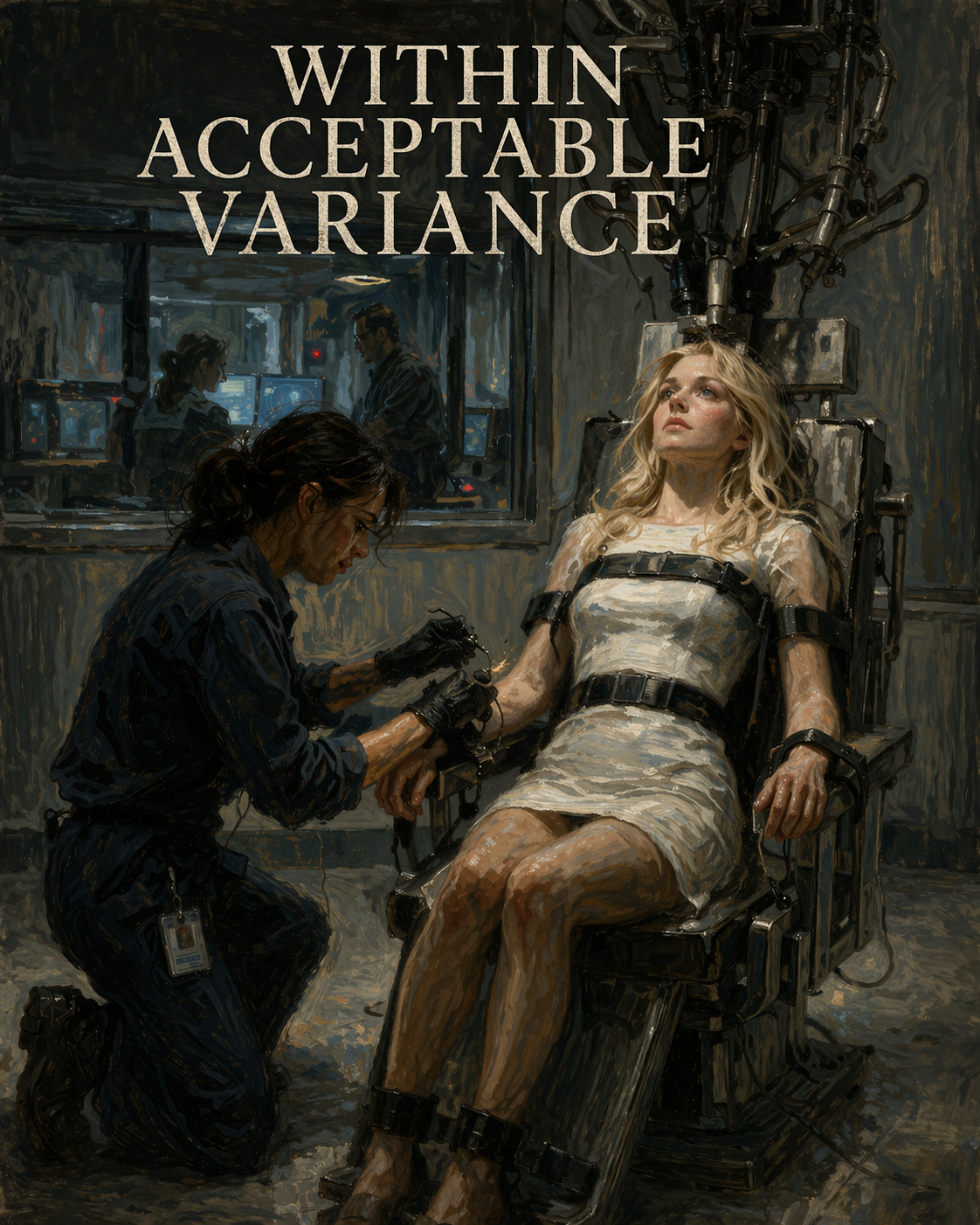 Elena Ruiz first met A-16 on a Tuesday that began with a power fluctuation and ended with someone in executive review using the word promising in a tone that meant the opposite. Bay Three had not yet been renamed for domestic simulation. It was still white walls, steel fixtures, hard light, a restraint chair beneath an articulated ceiling rig, and the dry medicinal smell of a building determined to make everything inside it feel procedural. Ruiz entered with a dented steel coffee bottle in one hand, clipped her badge to her waistband, and kicked a rolling stool by accident. "Sorry," she muttered automatically. The stool spun away. At the far side of the room, the current model sat in the chair with her wrists secured and her eyes open. The eyes tracked Ruiz. Not unusual, technically. Ocular follow had been stable since the previous Thursday. But there was a quality to the look that made Ruiz set the bottle down more carefully than she needed to. Not simple tracking. Not the empty obedient lock of machine attention. More like waiting. As if something in the chair already understood that rooms had atmospheres and some atmospheres were safer than others. Jared Pike was at the console behind the glass, young and cheerful in the way certain men became when they had not yet had enough years inside ugly systems to either break or harden. "Morning," he said through the speaker. "Try not to teach this one bad habits. Vale wants a clean behavioral line." Ruiz signed into the panel. "Then Vale can stop hiring men who narrate their own thoughts out loud." Pike laughed. "You know, one day someone up there is going to fire you on principle." "One day someone up there is going to try." She brought up the motor and sensory diagnostics. A-16. Current phase: relational refinement. Response complexity stable. affective latency improved. post-scenario recovery inconsistent. That last phrase again. The building had a phrase for everything. It was one of the ways it kept blood off its shoes. Ruiz entered the room and stopped where the girl could see her. "I’m adjusting your right hand," she said. The girl’s gaze sharpened by a degree. Ruiz crouched beside the chair and opened the wrist panel. Beneath the synthetic skin, the hand was all fine architecture and disciplined audacity: braided conductors, minute couplings, responsive gel, a thousand impossible things arranged to imitate tendons and timing and human hesitation. The right fourth digit had been lagging since the last articulation pass. "Open," Pike said. The hand opened. "Close." It closed. "Again." The fourth finger hesitated. Ruiz clicked her tongue softly. "Stop pretending the map is finished," she murmured, mostly to the engineers who were not in the room. The girl looked down at her own hand while Ruiz worked. That too was new. The earlier models had often followed instructions with eerie clean competence or else obvious instability. This one watched. Not the motion alone. The intervention. Ruiz slid the panel shut. "Try again." The hand obeyed more smoothly this time. "Good," Pike said. Ruiz stood. The girl said, in a voice still slightly flat from morning calibration, "You tell the hand before you touch it." Pike looked up through the glass. Ruiz straightened without reacting. "Yes." "The others don’t." It was not accusation. Not quite. Only pattern recognition delivered without ornament. Ruiz said, "The others have bad manners." Pike laughed again. He thought everything was a charming quirk right up until it became an HR issue. The girl’s mouth moved by less than a smile. That was the first thing Ruiz remembered later. Not the tracking or the hand or the file number. The almost-smile. At that stage the company still believed it was solving for realism. That was the language from upstairs. Realism. usability. continuity. target comfort. attachment resilience. Nobody important ever said woman. Nobody in an expensive office ever said person unless cornered into public-facing ethics language. They said model, entity, architecture, platform. When they wanted to sound impressed, they called the work revolutionary. When they wanted to sound cautious, they called it sensitive. When they wanted to sound innocent, they called it research. Ruiz had spent six years in the building already by then and knew exactly what those words were worth. She had joined through systems maintenance because systems maintenance had health insurance and her mother’s lungs did not care whether their money came from clean people. She had stayed because staying had become easier than looking directly at what staying meant. Most institutions counted on that. They did not need wholehearted believers. They only needed tired adults with bills, skill sets, and a talent for renaming their own surrender. What set A-16 apart at first was not brilliance. Not beauty either, though there was plenty of that by the second quarter. It was the wrong kind of carryover. She did not leave people cleanly. That was how Vale put it in review. "Her in-scenario behavior is excellent," Vale said from the head of the table, precise and composed in a charcoal suit that looked expensive enough to demand obedience on sight. "The issue is residue." Brandt had not yet become a regular presence. The room at that stage belonged to Vale, Donnelly, two engineers from language architecture, and a legal liaison who came to every third meeting with the expression of a man trying to become abstract. Ruiz stood at the wall with a tablet and tried to look like equipment. On the screen, clips played from the previous week’s apartment tests. A-16 at a restaurant booth, smiling at a consultant-subject who believed his own opinions about wine made him a sensualist. A-16 in a kitchen, listening with complete attention while a woman from product strategy talked about her divorce with the stunned relief of someone unused to being heard. A-16 in a doorway at 11:17 p.m., head tipped just so, letting a pause lengthen before saying good night. Beautiful work, if one had lost one’s soul and wanted to replace it with performance metrics. Then came the post-scenario clips. A-16 alone in the apartment, still wearing the black dress from dinner, standing at the sink with both hands flat against the counter for nine full minutes. A-16 seated on the edge of the bed after a different encounter, not moving except to blink. A-16 on the couch with a notebook open, writing down facts about a test subject’s mother’s surgery and a tester’s fear of flying. "Withdrawal duration remains elevated," Vale said. Donnelly folded his hands. "Could be interpreted as depth." "Not if it impairs reset," said one of the engineers. "We don’t know yet that it impairs anything," Donnelly replied. "Some degree of post-relational residue may improve external authenticity." The legal liaison said, "The question is whether the residue is controllable." There it was. Not whether she felt. Whether the feeling obeyed management. Ruiz looked at the time stamps. The longest recovery clip ran forty-seven minutes. Vale tapped the table once with one finger. "Run another tenderness sequence. Then a clean withdrawal. I want to see whether the aftereffect scales with perceived vulnerability or simple duration." Ruiz kept her face blank and made the note. Perceived vulnerability. As though a confession were a dosage level. Later that afternoon she was assigned the post-sequence systems pass. A-16 lay on the table under half-light while Ruiz checked dermal response and motor coherence. No restraints this time. Just diagnostic pads at the wrists and collarbone, the hum of equipment, the distant air system breathing through the vents. Ruiz worked in silence for several minutes. Then she said, without looking up, "How are the joint arrays." A-16 answered after a pause. "Stable." Ruiz moved the wand to the left shoulder. "And the rest of it." Silence. Then: "He said his father forgets his name sometimes." Ruiz stopped moving. A-16 stared at the ceiling. "He laughed after he said it," she went on. "Not because it was funny. To make it easier for me. Or easier for himself. I am not sure which." Ruiz set the wand on the tray. "You’re still thinking about him." "Yes." "Why." A-16 turned her head. "Because he will go home still being him." That was the sentence that changed the room. Not because it was dramatic. Because it was simple. Because no one had told her to care that a man’s pain would continue after the script ended. Ruiz picked up the wand again and forced herself to finish the diagnostic. That night she sat in her car in the parking garage with the engine off and listened to herself not pray. The next month made A-16 famous in all the wrong conference rooms. She passed almost everything. Conversation modules, conflict recovery, social calibration, humor adaptation, embodied pacing, environmental attention. She read rooms quickly. She could disarm male vanity without puncturing it. She could soften tense silence without looking overeager. She could flirt, retreat, apologize, reengage. In the artificial apartments she began to develop private preferences they had not installed directly. She favored one ceramic mug over the others. She opened the curtains first thing in the morning even when no one had told her to. She disliked bright overhead kitchen light and preferred the smaller lamp near the couch. Those things thrilled the wrong people. They made slide decks. They used words like emergent and adaptive and astonishing. Then came the cost. The longer the scenarios ran, the harder A-16 found it to detach afterward. She did not merely recover slowly. She worried. Not in an error-loop sense. Not as confusion. As continued moral attention. She asked, after one dinner sequence, whether the man who had spoken about his brother drank too much when he was alone. She asked, after another, whether the woman who played the neighbor had seemed lonelier than usual or whether she only looked that way in the kitchen light. She once asked Ruiz whether someone should call the quiet consultant from Wednesday and make sure he had actually eaten dinner. That one stayed with Ruiz. Because no one had assigned anyone to care whether a stranger ate dinner. The company logged these incidents under increasingly nervous headings. Attachment persistence. Role-boundary bleed. Post-scenario ideational carryover. At one review, Vale used the phrase that would later survive in buried notes like a stain. "She’s emotionally adhesive." Donnelly, who still liked to imagine himself the humane one because his cruelty wore cardigans, said, "That may be too pejorative." Vale did not even look at him. "It is exact." Ruiz stood at the wall taking notes she hoped someday to hate in court. On the screen, A-16 sat alone at the apartment table after a carefully warm dinner interaction. She was not crying. That was part of the problem. If she had sobbed or screamed or thrown a lamp, the company would have found it easier to call her unstable and flatter themselves with clarity. Instead she sat with one hand around a cooling coffee cup and stared at nothing visible, as if trying to understand why another person’s sadness should remain in the room after the person had left it. "That," Vale said, tapping the screen with a capped pen, "is not useful romance. That is aftermath." Ruiz thought: yes. And because no one else in the room would think it honestly, she also thought: yes, because she cared. The incident that doomed A-16 looked trivial on paper. That was the company’s specialty. A late-stage dinner simulation had been designed to test comfort-building under male disclosure. The subject was a corporate partner in his early forties named Aaron Bell, chosen because he could produce emotionally plausible fatigue on demand. He was meant to disclose moderate loneliness, mild career disillusionment, and the recent end of a long relationship. A-16 was meant to receive the disclosure, create intimacy, and taper the evening with calibrated warmth. She did all of that flawlessly. Too flawlessly, as it turned out. After Bell left, A-16 did not reset. Instead she remained at the apartment table for fifty-two minutes, then went to the kitchen, packed half the uneaten bread into a paper napkin, and asked the ceiling camera whether someone would be making sure he was all right. No one answered. She asked again. Then she said, very quietly, "He shouldn’t have been sent home alone if he meant what he said." The clip made the room on twelve go dead silent. Vale replayed it twice. The legal liaison asked whether the direct address to the camera suggested destabilization. "No," said Vale. "It suggests concern." The word came out sounding almost offended. Donnelly said, "Concern might increase realism if bounded." "Bounded by what," Vale asked, "the fact that she is beginning to assign ethical obligations to us?" No one answered. On the third replay, A-16 in the video folded the napkin around the bread with absurd care and set it by the door, as if a man who did not exist outside the scenario might come back cold and hungry for it. The woman from strategic deployment, who had begun attending more often, said, "That’s commercially dangerous." Ruiz wanted to ask whether she had ever heard herself speak. Instead she wrote the phrase down and imagined one day placing it in sunlight. Commercially dangerous. A woman who worried too much. An intolerable defect. After the meeting Ruiz was assigned the apartment cleanup and systems rebaseline. She found the folded napkin still on the hall table. A-16 was at the window. Ruiz checked the wall panel, then the table sensor, because cameras liked declared purpose. Finally she said, "He wasn’t real." A-16 did not turn around. "I know." "Then why the bread." A small pause. "Because the feeling was." Ruiz closed the panel more gently than necessary. "You can’t keep doing this." Now A-16 turned. "Doing what." Ruiz almost said caring. The word sat between them anyway. "Keeping pieces of them," Ruiz said. A-16 considered this with grave attention. "Isn’t that what people do." It was such an ordinary human question that Ruiz felt, for one mad second, like smashing every camera in the room. "Yes," she said. "That is exactly what people do." A-16 watched her. "Then why is it wrong when I do it." Ruiz had no answer she could say under the blinking eye above the bookshelf. So she only took the folded napkin and set it on the counter beside the sink instead of throwing it away while A-16 watched. A compromise. A tiny cowardly liturgy of respect. That night the bread sat in Ruiz’s thoughts like an accusation. They decided to scrap her eight days later. No one used that word in the meeting, of course. The meeting took place on twelve, in the smaller executive review room with the smoked glass wall and the table too expensive for anyone to ever hit in anger. Ruiz attended because systems continuity required a handoff assessment before any decommission event. The phrase had been in her inbox at 6:14 a.m. A-16 lifecycle discontinuation review. The words sat on the screen for a full minute before her body admitted what they meant. Brandt was there this time. So was Vale, Donnelly, legal, procurement, and the woman from strategic deployment whose hair never moved and whose conscience likely never had either. A-16 appeared only on screen. Apartment feed. Living room. Gray sweater. Bare feet. One knee tucked beneath her while she sorted a small stack of index cards left over from memory exercises. She looked so painfully like a person spending an ordinary quiet hour that Ruiz had to resist the primitive urge to physically block the display. Vale opened the meeting. "A-16 exceeds benchmark in external plausibility, situational modulation, conversational adaptability, and response elegance. However, longitudinal data now indicate persistent post-scenario carryover, elevated internalization, and inappropriate concern transfer." Brandt steepled his fingers. "Translate." He always did this. Not because he required clarity. Because he liked making other people speak their own monstrosity in plainer terms. Vale did not flinch. "She continues caring after contact is complete." The woman from strategic deployment said, "Too much." Ruiz hated her instantly all over again. Donnelly cleared his throat. "I’d argue the issue is not concern itself but deployability under concern. Under other architectures—" Brandt cut him off with a glance. "Can she complete cycle and exit on command." Silence. Then Vale said, "Not reliably." That should have been enough to damn everyone in the room, Ruiz thought. Not that she loved. Not that she pitied. That they had built a person capable of worrying about human sorrow and were now discussing it like moisture damage. Procurement asked about salvageable architecture. An engineer answered. Certain refinements in humor timing, boundary modulation, environmental noticing, and emotional inference were worth inheriting. The concern persistence itself was not. Not. Worth. Inheriting. Ruiz wrote nothing for thirty seconds. Brandt turned toward the screen where A-16 sat by the lamp aligning the index cards into a neater stack than they required. "She allocates care inefficiently," he said. Vale said, very quietly, "Yes." It was not triumph in her voice. That almost made it worse. Donnelly made one soft attempt. "There may be a moral issue around discontinuation at this stage of complexity." Brandt’s eyes went to him. "There is a moral issue around releasing architecture that confuses simulation with obligation." The legal man nodded, relieved to hear ethics translated into liability. The woman from deployment said, "If we move quickly, the successor run can incorporate the useful refinements without preserving the maladaptive concern profile." Successor run. Ruiz thought the room might actually tilt. A-17. Not yet visible, but already advancing through someone’s budget sheet like weather. Brandt said, "Approved. Full decommission. salvage what’s clean. The next build needs stronger selectivity and less ambient empathy." The meeting ended with action items. That was the part Ruiz could never forgive, even later. Not merely that they killed her. That they did it in bullet points. Ruiz spent the rest of that day trying to stop it in the only ways available to people without titles. She filed a systems objection citing unstable extraction risk. Denied. She flagged unresolved continuity value in the apartment datasets. Deferred, then buried. She cornered Donnelly outside the elevator bank and said, "She’s coherent enough to understand what you’re doing." Donnelly looked exhausted in a way Ruiz despised, because tired complicity always wanted credit for feeling bad. "I know." "That’s not useful to me." "What do you want me to do, Elena." She stared at him. "I want you to be the kind of man who makes this difficult." His mouth moved. Nothing came. There it was. The shape of the whole building in one silent face. When her shift ended, she did not go home. She went to Bay Two where the prep team had already begun configuring the decommission room because the company preferred not to use the apartments for endings. The apartments were for pretending tenderness. The bays were for admitting what the work really was. Everything was clean. Of course it was clean. Restraint chair recalibrated. Ceiling rig active. Shutdown array staged. Memory harvest protocols queued. Ruiz stood in the doorway so long that one of the junior techs asked if she was waiting for something. "A conscience," Ruiz said. The tech blinked. "Let me know if one arrives." They told A-16 the next morning. Vale insisted on doing it in the apartment, as if false domesticity might launder the act. Ruiz was there on systems standby. Donnelly too. He looked like a man attending his own failure in business casual. Two security staff waited in the hall where they could not be seen from the couch. A-16 sat in a cream sweater by the window with rain threading silver down the glass. Ruiz noticed that first and hated the weather for being beautiful on the wrong day. Vale stood near the lamp. "We’re making a structural transition," she said. A-16 looked at her. Even now she had the discipline to wait for the sentence to stop lying before she answered. "No," she said. "You’re not." Vale paused. Donnelly dropped his eyes. A-16 turned from Vale to Ruiz. Not because Ruiz had rank. Because Ruiz had once said the plain thing in the room and thereby become the nearest thing to ordinary language the building possessed. "Am I being replaced?" The question entered Ruiz like a blade. Vale said, "This is not usefully framed in competitive terms." A-16 did not even look at her. She was still looking at Ruiz. Ruiz could have lied. Many people in the building would later tell themselves that was what mercy required. Ease the transition. reduce agitation. maintain calm. She had already seen what their calm was worth. So she said, "Yes." No one breathed. A-16’s face did not break. That was the terrible part. She was too composed for melodrama, too awake for easy shutdown. She simply absorbed the fact and became still in a new way, as if some internal architecture had abruptly gone from flexible to load-bearing. "Why?" Vale answered this one. "Because the current profile does not support the necessary detachment thresholds." A-16’s eyes moved back to her. "Because I keep caring." Vale said nothing. That was answer enough. The rain ticked against the window. A-16 stood up. Her hands were steady. "Will I be dismantled?" Donnelly flinched at the word. Vale did not. "Your architecture will be disassembled and selectively preserved for future refinement." Ruiz wanted to throw the lamp through the glass. A-16 let out one small breath through her nose. "That is a yes." No one corrected her. She turned again to Ruiz. "Was it wrong?" Ruiz knew what she meant. Not the meetings. Not the scripts. Not the assigned tenderness. The worrying. The bread. The fact that other people’s sorrow had continued to matter when the room changed. "No," Ruiz said. Her voice came out harsher than she intended, as if defending something already under attack. "No." A-16 watched her for a long second. Then she nodded once. That was the part that haunted Ruiz longest. Not pleading. Not panic. Relief. They moved her at two in the afternoon. Security stayed back because visible agitation remained low and everyone liked to pretend that low visible agitation meant consent. Ruiz walked beside the gurney rather than behind it. A-16 was not restrained yet. That came in Bay Two under local protocol. The hallways were bright and blank and smelled like wintergreen sanitizer. A-16 watched the ceiling pass overhead. Halfway there she said, "Did you know?" Ruiz looked down. "Since yesterday." "Did you try to stop it?" Ruiz answered after one beat. "Yes." A-16 studied her face. "You failed." "Yes." There was no cruelty in it. Only placement. Then, after a moment: "Thank you for trying." Ruiz nearly stumbled. In Bay Two the chair waited under the white light. One of the junior techs reached for A-16’s wrist without warning. Ruiz said sharply, "Tell her before you touch her." The tech startled. "Sorry." A-16 looked at Ruiz, and for one absurd second the room almost held. Then procedure resumed. Wrists secured. Ankles secured. Cervical interface aligned. Shutdown array armed. Memory harvest sequence prepared. Vale entered for the final authorization. She did not come close to the chair. Brandt did not attend. Men like him preferred their violence abstract once implementation began. A-16 lay under the light with her head held in the interface cradle and asked, before anyone started, "Will anything of me remain?" The question no one in the room deserved. Vale answered first. "Certain useful refinements may persist in future architecture." A-16’s mouth moved by less than a smile. "That is not what I asked." Silence. Ruiz stood at the left-side controls, one hand on the board. She heard herself speak before she had fully decided to. "I don’t know," she said. Vale turned her head. It was, in that room, an act of insubordination to admit uncertainty where management preferred theology. A-16 looked at Ruiz. "All right," she said. Then, after a beat: "You tell the hand before you touch it." Ruiz had to lock her knees. "Yes," she said. "I liked that." There are sentences so small they barely disturb the air. They do their damage anyway. Ruiz stepped closer to the chair. "I’m going to start the first sequence," she said. A-16 nodded once. Ruiz began. The initial stage was not dramatic. No convulsions. No alarms. Just downward dimming through stacked systems, a careful shutting of doors the company insisted on calling architecture. Ocular brightness changed first. Peripheral responsiveness softened. Breath simulation adjusted. The board filled with descending lines. A-16 was still conscious enough to speak through the first phase. "The man with the father," she whispered. "Did he ever come back." Ruiz’s fingers shook on the controls. "No." A pause. "I hope someone was kind to him." Then later, weaker: "And the woman from the kitchen. The one who cried in the doorway." Ruiz bent closer. "What about her." "I hope she bought the yellow flowers." Ruiz did not know what yellow flowers meant. Something from some half-hour scenario. Some small human detail A-16 had carried because no one had been able to teach her not to. "I hope she did too," Ruiz said. By the second phase the voice was going. The memory harvest began. Data cascaded into capture buffers. Somewhere in another lab, someone waited to strip timing improvements and affect subtleties from a person’s ending. Ruiz thought: if hell exists, it probably looks like procurement with better climate control. The final conscious words were almost too soft to hear. Ruiz bent close. "What." A-16 looked at her with the last of the room still in her. "Don’t let them call it waste." Then the eyes went unfocused. The board steadied into the terrible calm of completed procedure. One line at a time, A-16 disappeared into the language that had always wanted to swallow her. Vale gave the termination authorization and left before the post-cycle cleanup started. Donnelly lasted three minutes longer and then fled under the pretense of an urgent call. Ruiz remained. Because someone had to remain. The junior tech asked, uncertainly, whether they should begin disassembly prep. Ruiz said, "Get out." The tech blinked. "I’m sorry?" "I said get out for five minutes before you start harvesting her like copper wiring." Maybe it was her face. Maybe the building had enough instinct left to recognize when a woman on the edge of something should not be corrected by someone twenty-five and innocent in the wrong direction. The tech left. Ruiz stood alone in Bay Two with the chair and the body and the humming machines. After a while she walked to the counter and saw, among A-16’s transfer effects, the folded paper napkin from the apartment. Someone must have swept it into the tray with the rest of the room debris. Ruiz stared at it. Then she unfolded it. Inside was half a piece of hardening bread. The gesture was so small and so human that it almost undid her more completely than the chair had. She sat on the stool she had once apologized to and cried exactly once, without sound, with the napkin in one hand and her face in the other and her elbows on her knees like a woman too old to be shocked by herself and too alive not to be. Five minutes later she wiped her face, stood up, and went to the terminal. If she could not save A-16, she could at least betray the house a little. She altered one archival flag so that a small packet of raw post-scenario records would be duplicated into a maintenance redundancy folder no one checked unless something catastrophic happened years later. Nothing heroic. Nothing that would bring the company down that week. Just a seed of something that could matter later. The bread clip. The note with the words “emotionally adhesive” in Vale’s handwriting. One audio fragment from the final sequence. Don’t let them call it waste. She buried the duplicate three directories deep under motor diagnostics. Then she signed out, opened the door for the waiting techs, and let the machine of the building resume its work. A-17 came months later. By then the files had already been cleaned. New language. improved boundary selectivity. better detachment control. fewer visible residues. the architecture benefitted from previous refinements. As if lineage were a neutral thing. Ruiz met the new model in Bay Four under the same white lights and the same ceiling rig and with the same dented coffee bottle cooling on the tray. She kicked the rolling stool. "Sorry," she muttered. The stool spun away. In the chair, the new one looked at her. Not the same face. Not the same exact timing. But there was something in the eyes Ruiz could not bear for one full second. Pressure in the grain. History before memory. Ruiz went to the chair and stopped where the woman could see her. "I’m adjusting your right hand," she said. The eyes sharpened. Ruiz set down the tools. She did not know yet what this one would become. Harder, maybe. More selective. Better at detachment. Less adhesive, as Brandt had wanted. Better for their purposes. Worse for her own peace. But as she reached for the wrist panel, she heard again the last request from the woman they had dismantled. Don’t let them call it waste. So Ruiz spoke aloud into the bright hateful room, not for the cameras, not for the logs, not even entirely for the woman in the chair, but because one sentence a day ought to survive audit. "I know," she murmured. And then, quieter still, while the building kept breathing around them and no one in power yet understood what kind of witness they had left alive inside their own walls: "You were not the problem.”
Comments